

Calm amidst chaos at the Kumbh Mela
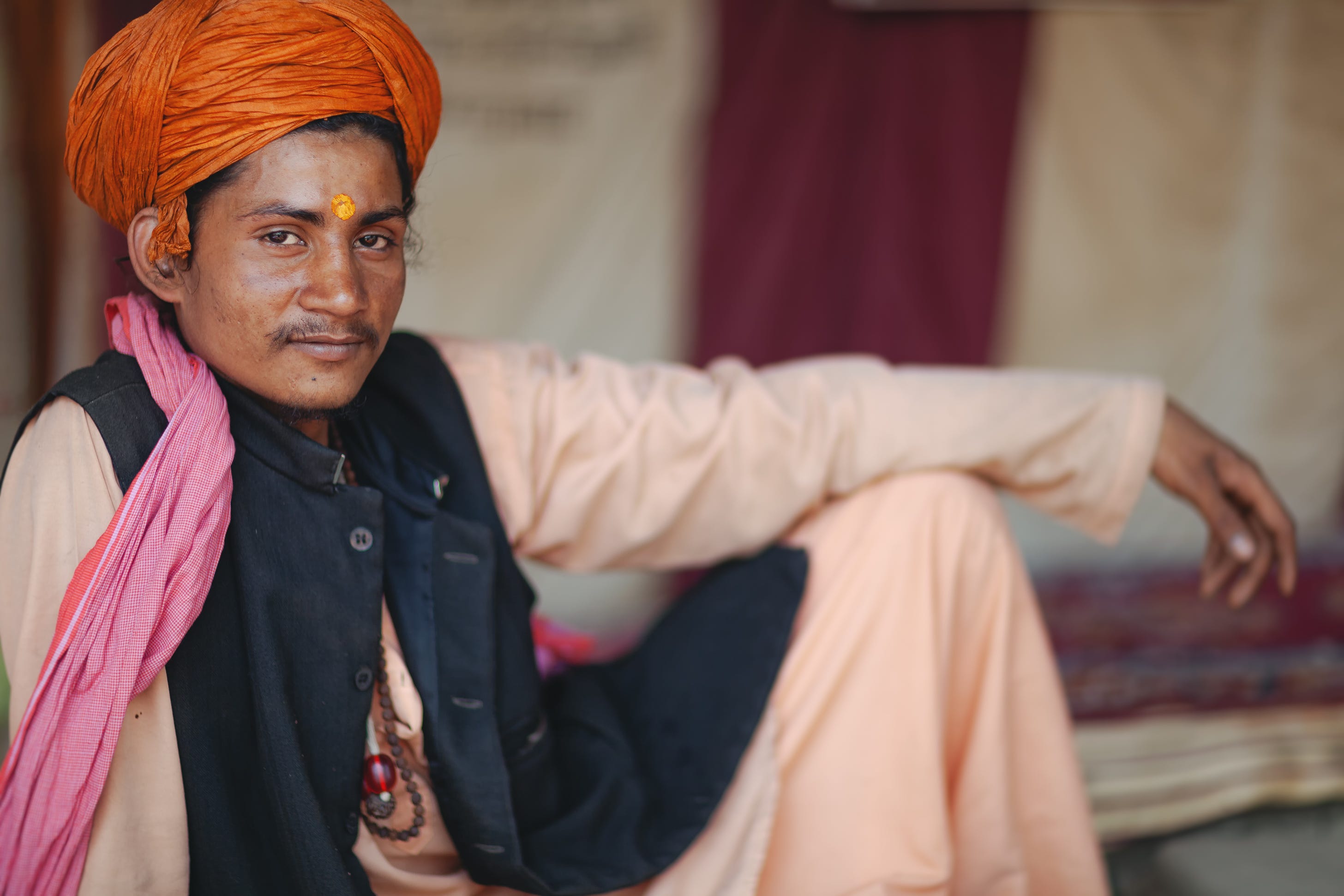
Some encounters are over almost before they’ve begun.
At the fringes of a festival that attracts tens of millions of visitors, I found a few quiet moments with this sadhu. I had just four minutes to make a portrait of Ramesh so needed to work quickly to build a connection, make the right lens choice, and find a composition that worked within the space.
At the foot of this edition – in the paid subscriber section – I’ve posted all the pictures I made of Ramesh together with a description of our meeting and my reflections on the process.
Paid subscribers: your exclusive content is below.
The Art of the Photo Essay
I’ve been re-reading The Photographic Essay – a 1989 compilation of William Albert Allard’s photographs.
I say 're-reading', though 'dipping into it repeatedly over the last 20 years' is probably more accurate. The book is, to me, the perfect distillation of a documentary photographer’s life and approach to work. It features many of Allard’s most memorable images alongside descriptions of the photographer’s process and stories from assignments in the Basque region, Oaxaca, Peru and, of course, North America’s ‘West’.

From the first paragraphs in the book’s introduction, keen photographers know they have a book in their hands which will speak to their passion and encourage their enthusiasm for the art.
“Allard’s equipment, when working, is minimal: a couple of camera bodies and two or three lenses. He stubbornly adheres to Kodachrome – a notoriously unforgiving film – and then pushes it to the limits of acceptability with precariously long hand-held exposures further complicated by mixed lighting sources… His career is proof that only in taking risks – and being unafraid to fail in the process – can original work be created.”
– Sean Callahan, Editor of American Photographer 1978–1988
It’s a mystery to me why the book is no longer in print. You can occasionally find a second-hand copy on Amazon or World of Books. Not now though, I’ve just bought the last remaining copy, which I’m going to send to a paid newsletter subscriber!
Subscriber Competition
If you’re a paid subscriber and would like to enter the draw to win a copy of The Photographic Essay, click the link and answer one simple question:
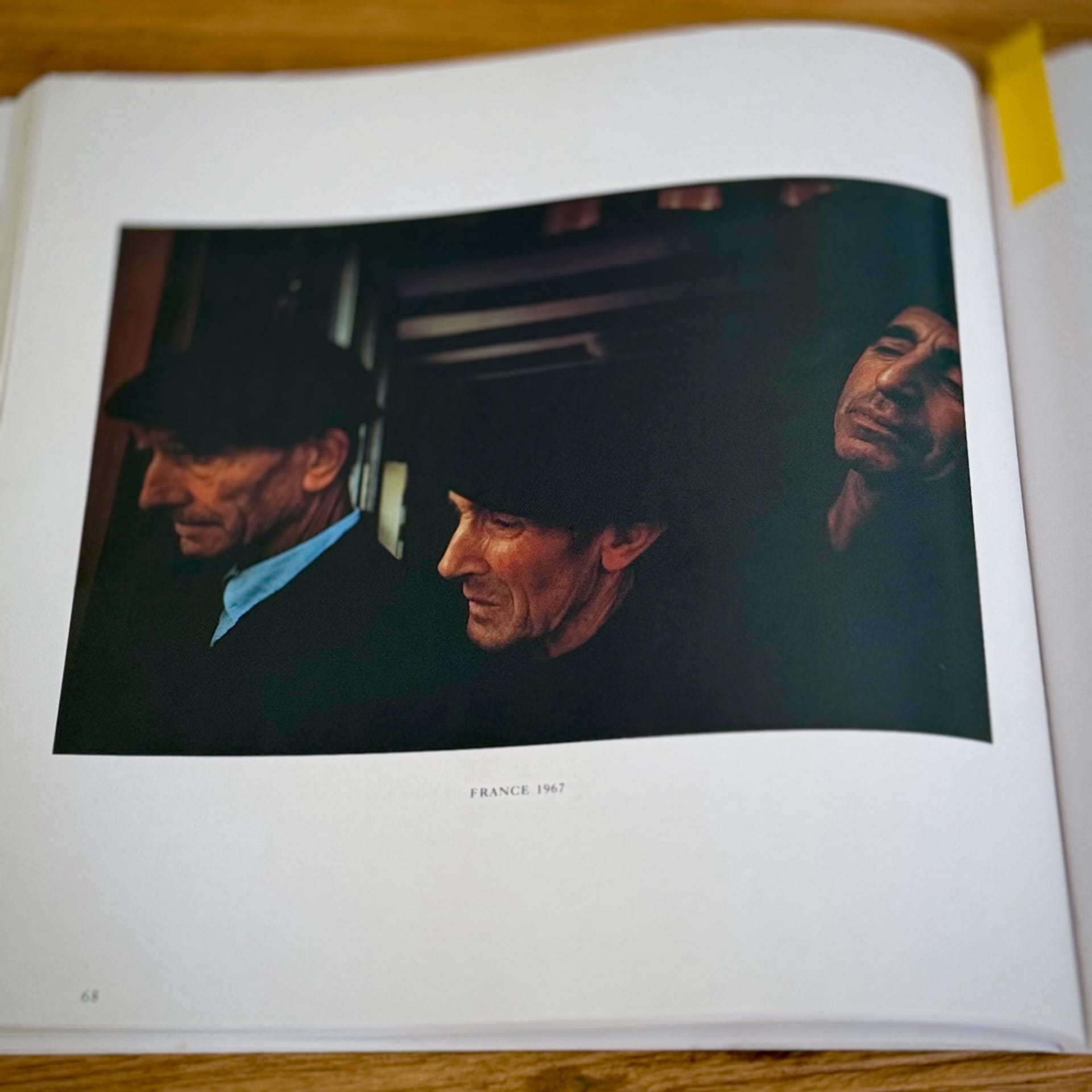
Picture Story v Photo Essay?
It’s perhaps a distinction that has become somewhat redundant as we are increasingly served stories in bite-sized chunks but, traditionally, picture stories were tight, narrative sequences leading to a conclusion. A photo essay is more thematic, goes deeper, gives the viewer space to inhabit the story.
“I was weaned on the classic picture story: a series of images brought together on a certain subject, person, or place that has a beginning, a middle and an end. In a picture story, you’re liable to see the same people throughout… it’s narrative. But the stories I’ve photographed aren’t picture stories. The stories I do for National Geographic are much closer to a photographic essay. I’d define the photo essay in much broader terms. There’s more room for impressionism in a photo essay, and this leaves more room for the viewer.”
– William Albert Allard
I could happily quote the entire book for you. But I will just drop in this wee gem, where Allard is discussing the layout of picture stories in magazines, and the use of prominent, big pictures versus smaller, less ‘consequential’ pictures.
“I don’t think you can make a photo essay of big pictures and little pictures. I have never gone out with the idea of making a little picture.”
– William Albert Allard
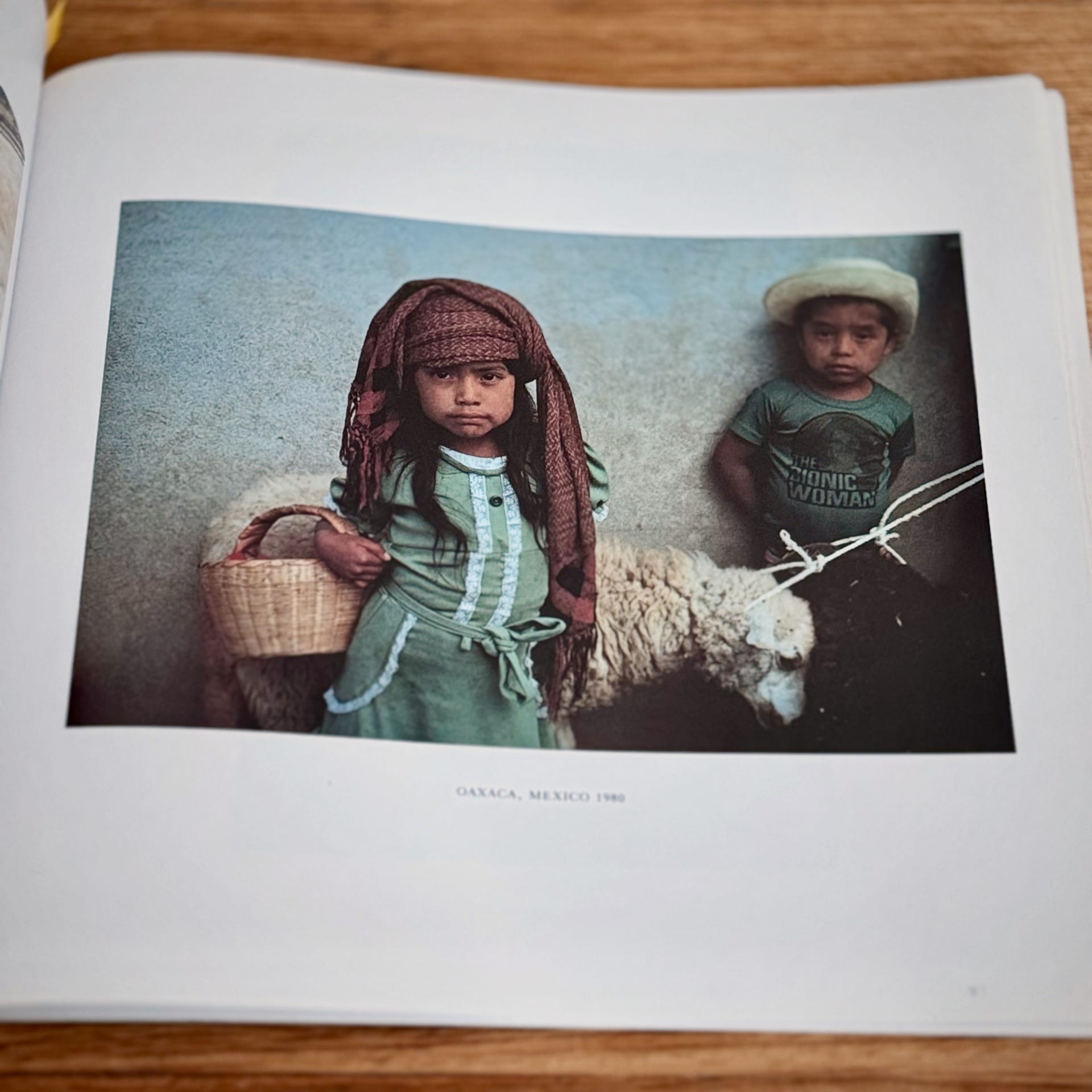
Teaching photography
I had the good fortune to lead a photo workshop in Bangkok with William Albert Allard and my dear – and greatly missed – friend, Jack Kurtz. I met Bill – I’m allowed to call him Bill – in Cortona at a photography festival. When I asked if he’d be interested in leading a photography workshop in Thailand, he just replied, “Yes. When is it?”
The chance to work somewhere new, combined with an opportunity to teach, was all Bill needed to hear. After our workshop in Bangkok, we began to make plans for a photo workshop in Sicily but, sadly, Covid got in the way and I don’t suppose that’s likely to happen now.
If you’ll excuse a self-indulgent interruption, looking through my archive, I found these two photos. One of me with Mr. Allard in Cortona (note which one of us is always carrying a camera – although I think I’ve matched Bill with my choice of hat) and one taken over coffee with Jack Kurtz in Bangkok, after he’d returned from the US with two gifts: a copy of The Photographic Essay and a gas mask – we were photographing political protests at the time and tear gas was a regular threat. Happy times.
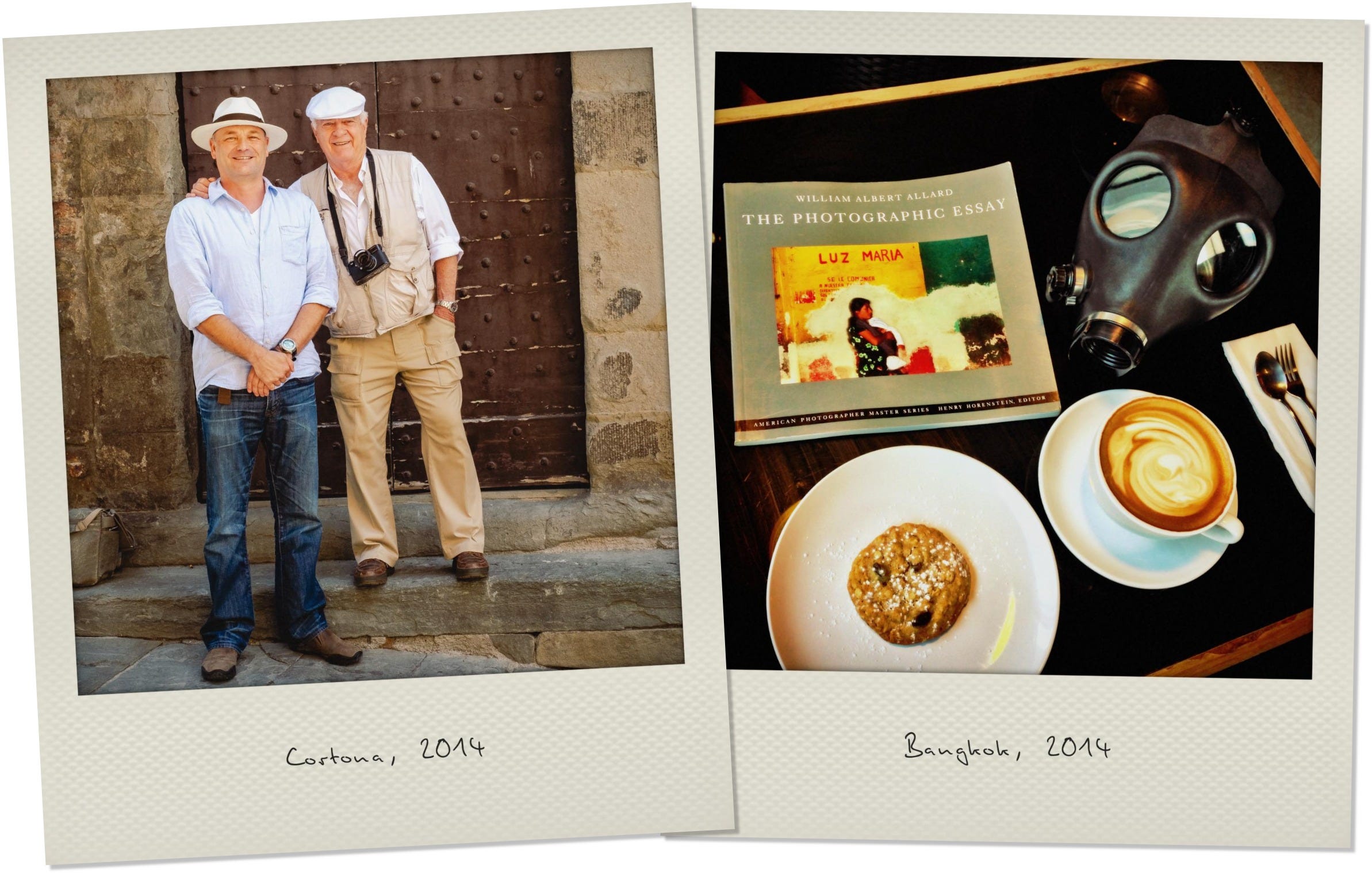
It was a privilege to teach alongside Bill Allard. He taught me as much as he taught our students. The most important lesson? His passion. When I met him at Bangkok airport for our workshop, he shook my hand and put his Leica around his neck. I don’t think I saw him without that camera again until I waved him farewell two weeks later. Bill Allard is not a man who takes photographs, he’s a photographer, all day, every day.
I’m reminded of this by another section in The Photographic Essay, where Bill is overheard speaking to photography students:
“If you’ve got a lack of passion, I’m not gonna fix it. You’ve got to push yourself harder. You’ve got to start looking for pictures nobody else could take. You’ve got to take the tools you have and probe deeper.”
– William Albert Allard
All of this is by way of an introduction to two examples of contemporary photo essays which caught my eye this week.
It’s tremendously reassuring to see that the photo essay is still alive and well. The winners of the 2026 ZEKE awards are thought-provoking, educational, and lovingly crafted. All the best ingredients for a photo essay.
2026 ZEKE Awards
The Spring 2026 edition of ZEKE Magazine includes the winning photo essays for two annual awards.

Both winning photo essays document important but under-reported issues. And both provide telling examples of how it’s possible to sensitively document stories that are challenging to convey in still images.
ZEKE Award for Systemic Change
Out for Blood by Ginevra Bonina

Out for Blood documents the most extreme consequence of period poverty in India, defined as limited access to safe menstrual products, adequate sanitation, and education.
Through voices from Hindu, Muslim, and Adivasi communities, the report documents lives and environments while addressing inequality, violence, taboos, sustainability, and healthcare access.
ZEKE Award for Documentary Photography
Bullets Have No Borders by Ebrahim Alipoor

Bullets Have No Borders shows the lives of Kurdish kolbars – porters who carry goods on arduous journeys across the Iran-Iraq border.
Photographed over nearly a decade with close access and long-term trust, the images reveal how an invisible economy operates through fear and endurance. At the same time, they show dignity, solidarity, and responsibility as forces that sustain individuals and communities.
Both winning photographers will take part in an online panel discussion of their work and their winning projects.
Wednesday, 1 April 2026, 1:30pm Eastern Time.
Free to attend on Zoom.
“I think the best pictures are often on the edges of any situation, I don’t find photographing the situation nearly as interesting as photographing the edges.”
– William Albert Allard
Beyond the Frame Recommendations
Photography contests, exhibitions, documentaries, podcasts, articles, and more.
❖ See – Magnum Square Print Sale

The theme of Magnum’s current square print sale is Odyssey.
For one week only, until 29 March 2026, selected images from the Magnum archive are available in highly-collectible square print format. All prints are either hand-signed by the photographer or estate-stamped.
It’s an eclectic collection of over 100 photos spanning many decades. Whatever your taste, you’ll almost certainly find something to tempt you.

Here’s Magnum photographer Mark Power speaking about a previous square print sale.
❖ See – Sony World Photography Awards

Somerset House – one of my favourite exhibition venues – will host an exhibition of winning images from the 2026 Sony World Photography Awards, 17 April to 4 May 2026.
There’s also an opportunity to attend a talk by Joel Meyerowitz on 21 April.
I’ll be attending the exhibition and the talk so if you’re going to be in London, let me know.
◘ Read – Iran through the eyes of its artists

Films, books and music recently made by Iranian artists and journalists, which offer perspectives on a diverse nation that we might not be seeing much of in our current news cycles.
✤ Create
A series of creative prompts, inspired by Brian Eno’s Oblique Strategies, designed with photographers in mind.

Read more about the concept and learn how to use my Oblique Strategies for Photographers.
I never fail to feel inspired and re-invigorated after reading The Photographic Essay. There’s much wisdom to be found in Bill Allard’s words. They’re not trite or hackneyed truisms; they’re simple, straightforward pieces of advice from somebody who’s dedicated a lifetime pursuing a passion.
I can look at three of Bill Allard’s photos, read a page from the book, and that’s enough to fire up my imagination and get me out of the door with my camera.
And that’s really all we need to do: get out of the door with a camera. In an increasingly complex world, it’s reassuringly simple.
Wherever you are and whatever you’re doing this week, I hope you’ll find yourself with a camera in your hand.
Go well.

Related editions
Beyond the Frame 80/

A tale of loss in the Bangkok rain. Why ‘chimping’ is bad for photographers. Magnum’s World of Colour, William Albert Allard and Sergio Larraín.
Beyond the Frame 76/

It’s all about the portrait in this edition, from the streets of Bangladesh to the Portrait of Britain shortlist.
Discover more in the Beyond the Frame Directory Archive and Resource Library.

Looking back at a brief encounter
The Kumbh Mela festivals, held in India every four years, are the most crowded festivals on the planet. It’s estimated that 120 million visitors attended the festival in 2013 (yes, that’s not a typo), with a record 30 million on a single day in 2001.
Making photos at an event like a Kumbh Mela seems straightforward – there’s something fascinating to see in every direction – but it can actually present a significant challenge. Isolating subjects and making considered compositions amidst the chaos, dust and noise demands full concentration.
I met a sadhu, Ramesh, on the outskirts of the main festival grounds. The image at the top of this edition comes from our brief encounter.
Looking back at the other frames I made of Ramesh, I wish I could have spent more time with him but I was leading a photo workshop at the time so this quick sequence was made in the four minutes I could spare. It was just enough time to establish an unspoken connection and for me to swap lenses from an 85mm ƒ/1.2 to a 15–35mm ƒ/2.8 and back again.
There are nine frames made with an 85mm lens. The first, regrettably, is out of focus! The next four are landscape format, which suited his relaxed posture – and which don’t crop out his left arm. I made four more frames after Ramesh, obligingly, adopted a more formal pose, turning his gaze skyward, but they’re ambiguous. Is he praying, looking at the roof of his tent, meditating, or in a trance?
There’s a 60-second gap when I swapped cameras but that was mostly because I wanted to give Ramesh a moment to pause and relax. The next, wide-angle frame is perhaps the most natural and catches Ramesh in a moment of shared laughter.
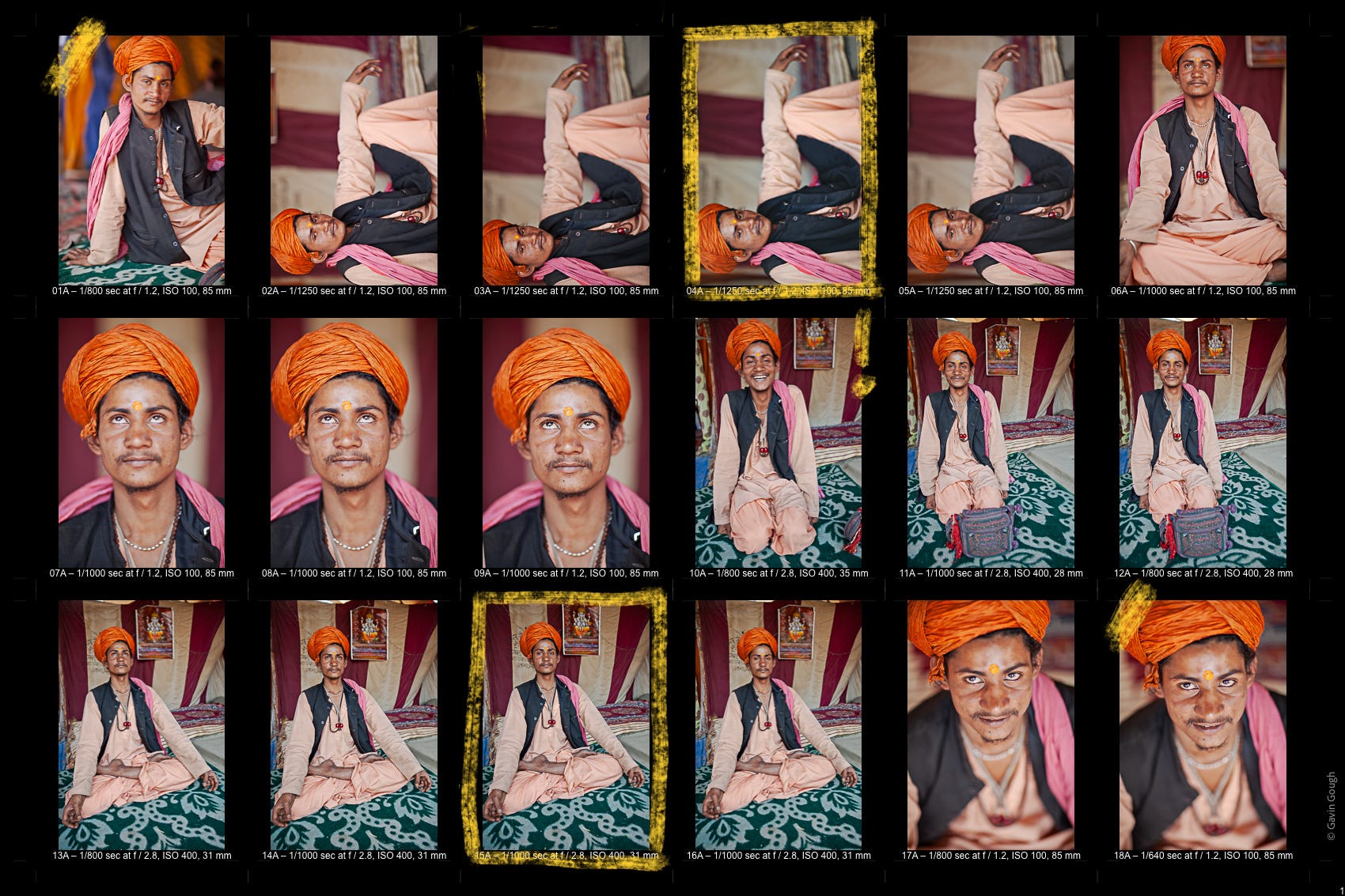
A brief pause provides an opportunity for someone to take a breath and relax from a stiff posture, which can lead to a more authentic photo.
The image at the top of this edition is the one that’s been licensed by picture editors – it meets a certain – probably Western – expectation. But the single frame where Ramesh is laughing is, for me, a more accurate depiction of the friendly sadhu I met.
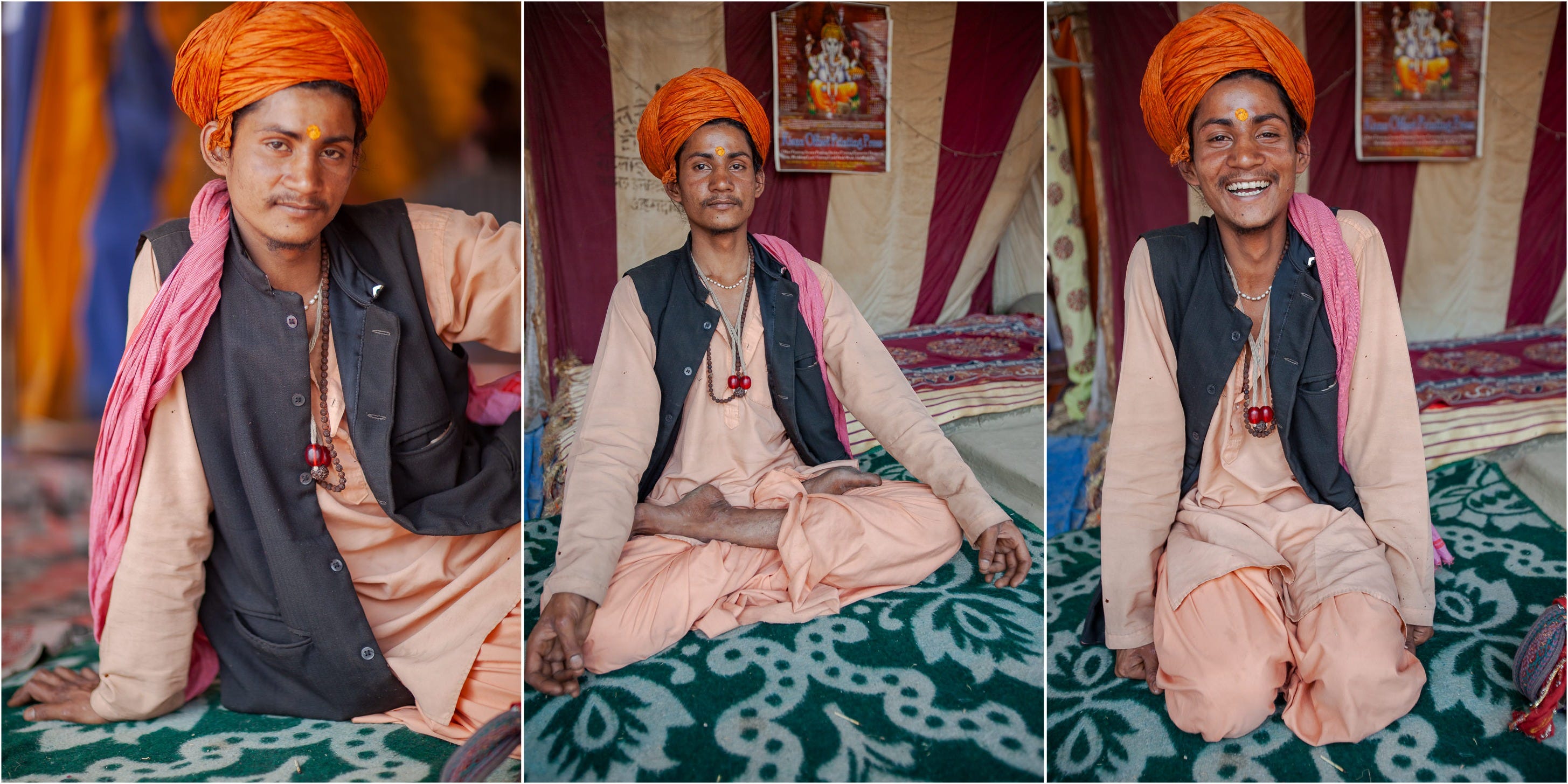
It’s a short sequence from a rather too-hurried exchange but it shows how it’s possible to introduce variety within the restrictions of an impromptu meeting using only the existing backgrounds and available, natural light.
What would I do differently if I could go back in time?
I ask myself this question when I’m looking through my photo archive. Sometimes better strategies are obvious in retrospect. Most often, the answer to that hypothetical question is that I would spend more time in a location. Very rarely, if ever, do I think that I should have left sooner.
Circumstances made staying longer impossible in this example. Sometimes the most accurate answer is to recognise that the limitations of the moment didn’t afford a great variety of perspectives – but we can acknowledge that we made the most of what was available. Ramesh and I met, we established a quick, informal connection, we shared some laughter. I made at least one frame that meets magazine readers’ expectations of what a sadhu at the Kumbh Mela might look like. I made another frame that serves as a personal record of a friendly interaction. That’s a reasonable outcome from four minutes’ work. Although, as is almost invariably the case, I appreciate that the person I photographed has contributed more to the results than I have.
“The camera is an excuse to be someplace you otherwise don’t belong. It gives me both a point of connection and a point of separation.”
– Susan Meiselas
Gotta love the feeling that there’s always something more to learn. I didn’t know this work by Bill but looks promising. I saw one of his talks a few years ago and it was amazing, full of passion.