

Light and Magic
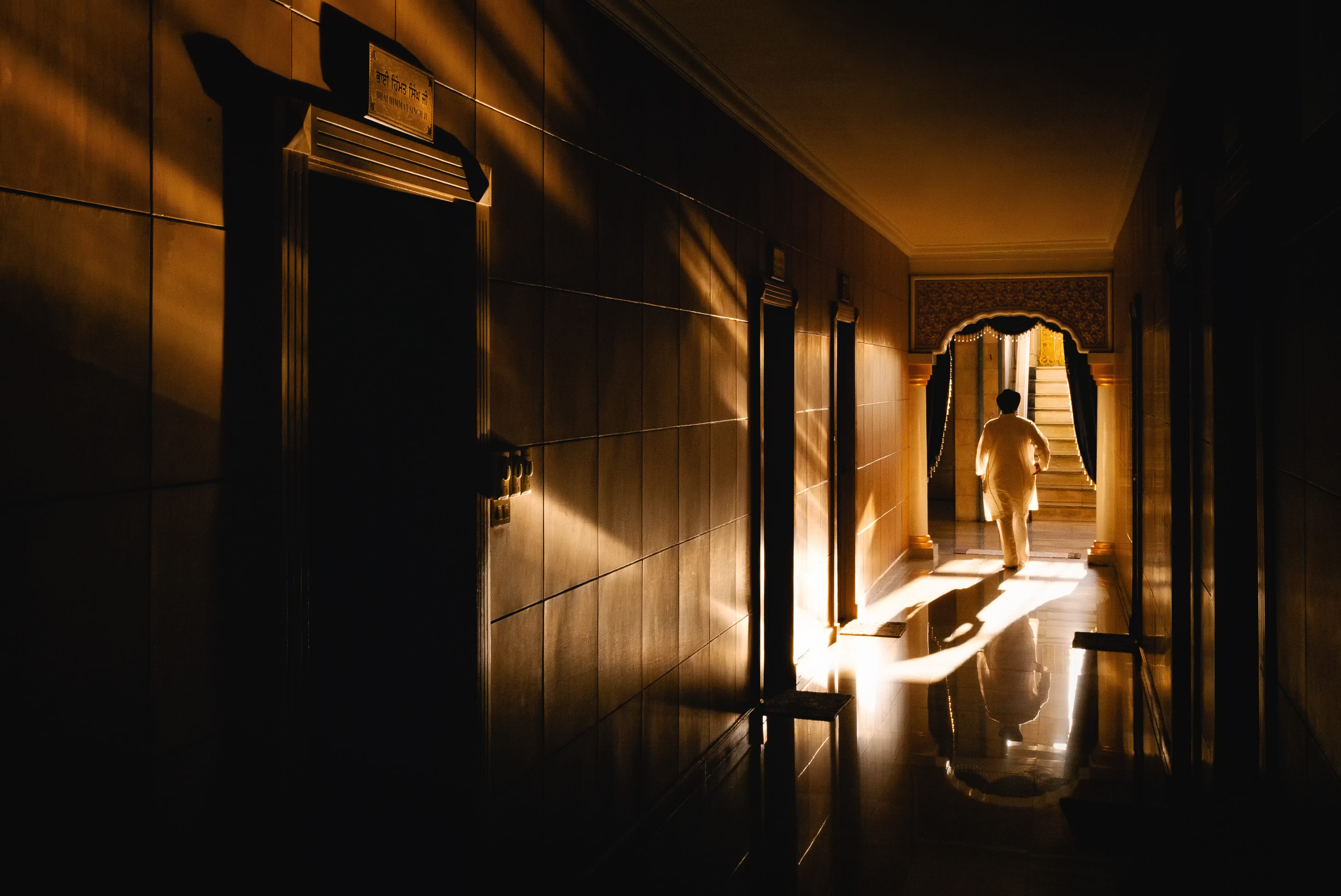
This edition is all about light and magic – which I hope might be said of every edition – specifically, the Light and Magic exhibition currently showing at London’s Tate Modern.
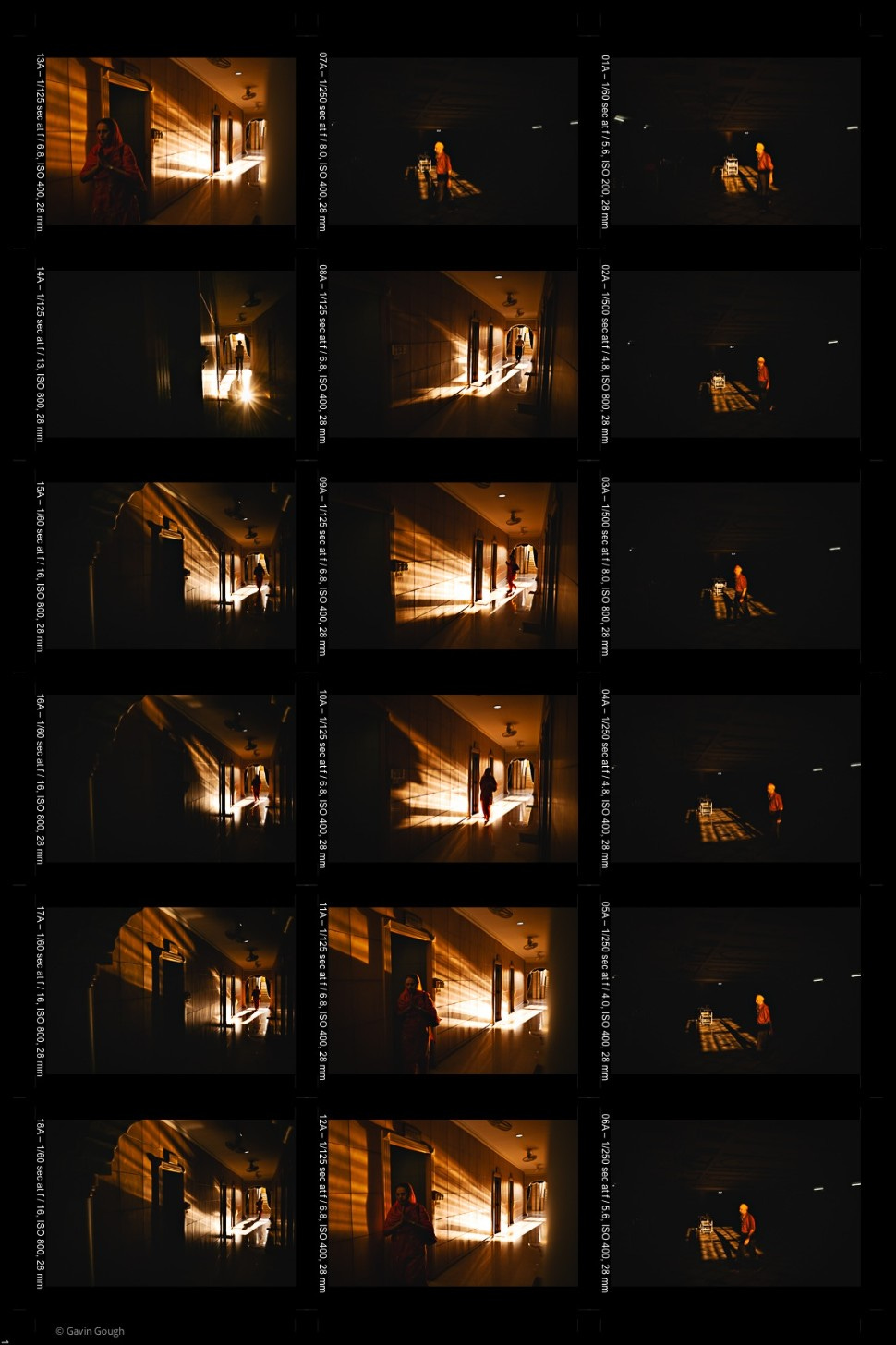
The light and magic in the photo above was seen at a Sikh Gurdwara in Thailand. I was there to photograph the central Darbar Sahib hall, where the holy Guru Granth Sahib scripture resides. Away from the main hall, sunlight was flooding through a southerly window into an otherwise unremarkable hallway. Sometimes light and magic can be found where you least expect it.
Pictorialism and the Birth of Art Photography
Many years ago, before mobile phones and TikTok, at the very start of my photography career, I met with an editor who asked me to describe my photographic style. At that time I aspired to be a travel photographer, so I described the sort of ‘blue skies and smiling faces’ images that were typical of Lonely Planet guidebooks at the time.
“Aha!” he declared, “So you’re a pictorial photographer.”
I nodded confidently, said “Oh yes, absolutely” – and made a mental note to look up the definition of pictorial as soon as I could find a dictionary. I had previously assumed pictorial meant possessing the properties of a picture – something to look at in a frame. His question implied something more specific.
The dictionary was no help: “Pictorial: adjective – pertaining to the nature of a picture”. I must have become distracted after that because I never did learn what is meant by pictorial photography. Looking back, I can’t be 100% certain that the photo editor knew any more than I did, but we’d both managed to sound like we knew what we were talking about and left the meeting happy. Ignorance is bliss, etc.
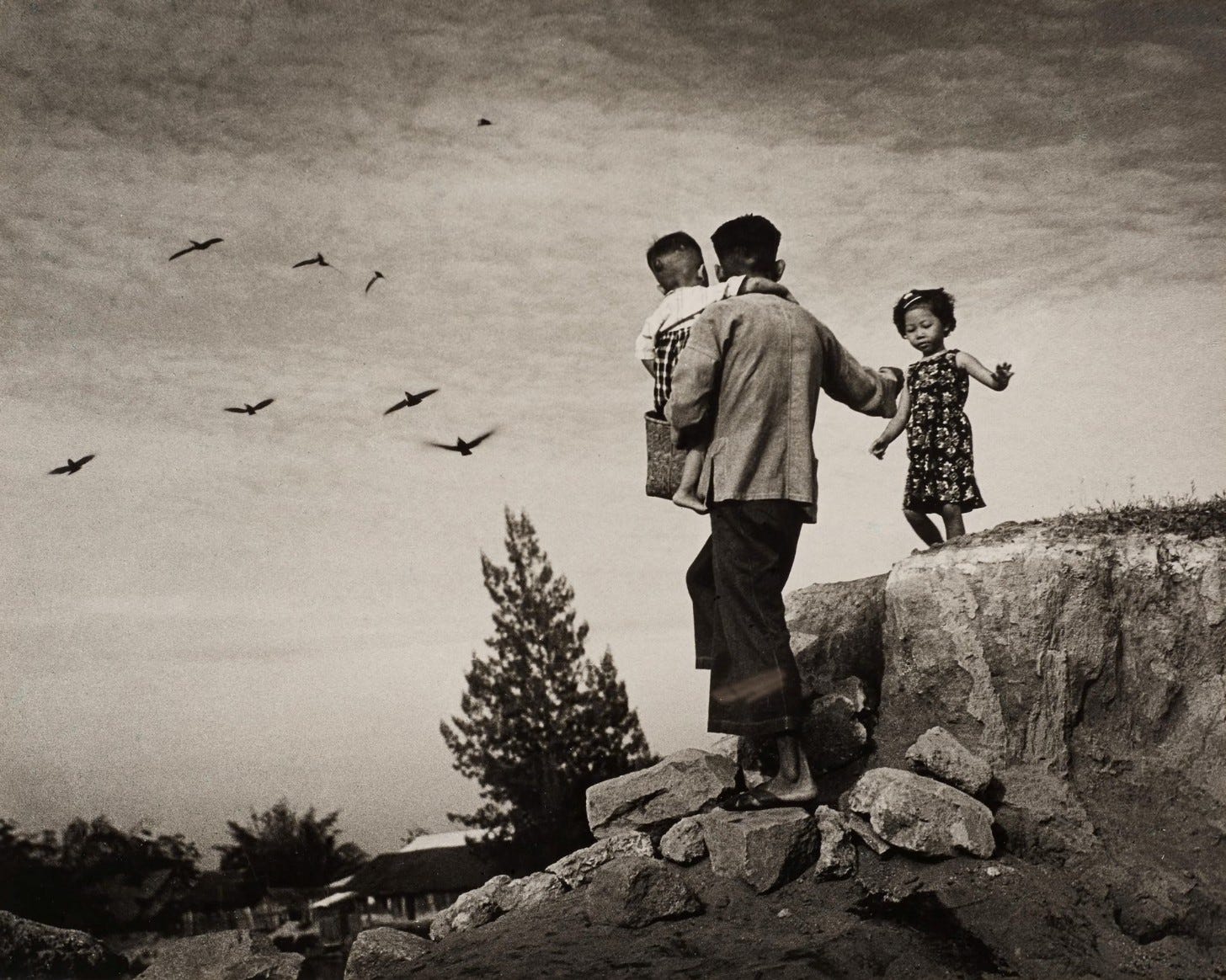
Decades have passed since that meeting and, finally, I might discover the true definition of ‘pictorial photography’. The Light and Magic exhibition, currently open in London, is described as “the first major exhibition to explore pictorialism as a global movement”. Hurrah!
I haven’t yet seen the exhibition in person, but having looked through the online galleries and read many reviews, I can at least tell you what pictorialism is not. It’s not documentary photography. It’s not photojournalism. This counts as progress.
In a lofty five-star review, the Guardian’s art critic describes Light and Magic as an “awe-inspiring” exhibition that shows “epic beauty in the everyday”. I’m a fan of epic beauty. Always have been. That’s why I married my wife.
Unfortunately, although the review also tells us that this is “the first retelling of the international, pluralistic pictorialism movement”, it goes on to admit that “this is not by any means a critical look at pictorialism”, which deflated my hopes somewhat.
A slightly less effusive review in Time Out notes that pictorialism is “an expressive, often vaguely defined, style of photography”. Vaguely defined? No kidding. The reviewer also confirmed my suspicion that “the terms of pictorialism are porous”.
For what it’s worth, here’s what I’ve concluded:
Documentary photography isn’t pictorial.
Every other photographic genre might be pictorial, depending on who you ask.
There’s little hope of pinning down something that experts in the field describe as “vaguely defined” and “porous”.
It probably doesn’t matter much.
In the context of the Light and Magic exhibition, pictorial is used to describe a shift in the late 19th century from photography as a scientific means of recording scenes to a more interpretive, more expressive medium on a par with painting and sculpture.
Whatever definition you’re happy to settle on, there’s no doubt that the pictures I’ve seen from the exhibition reviews are intriguing, sometimes ethereal, often beautiful.
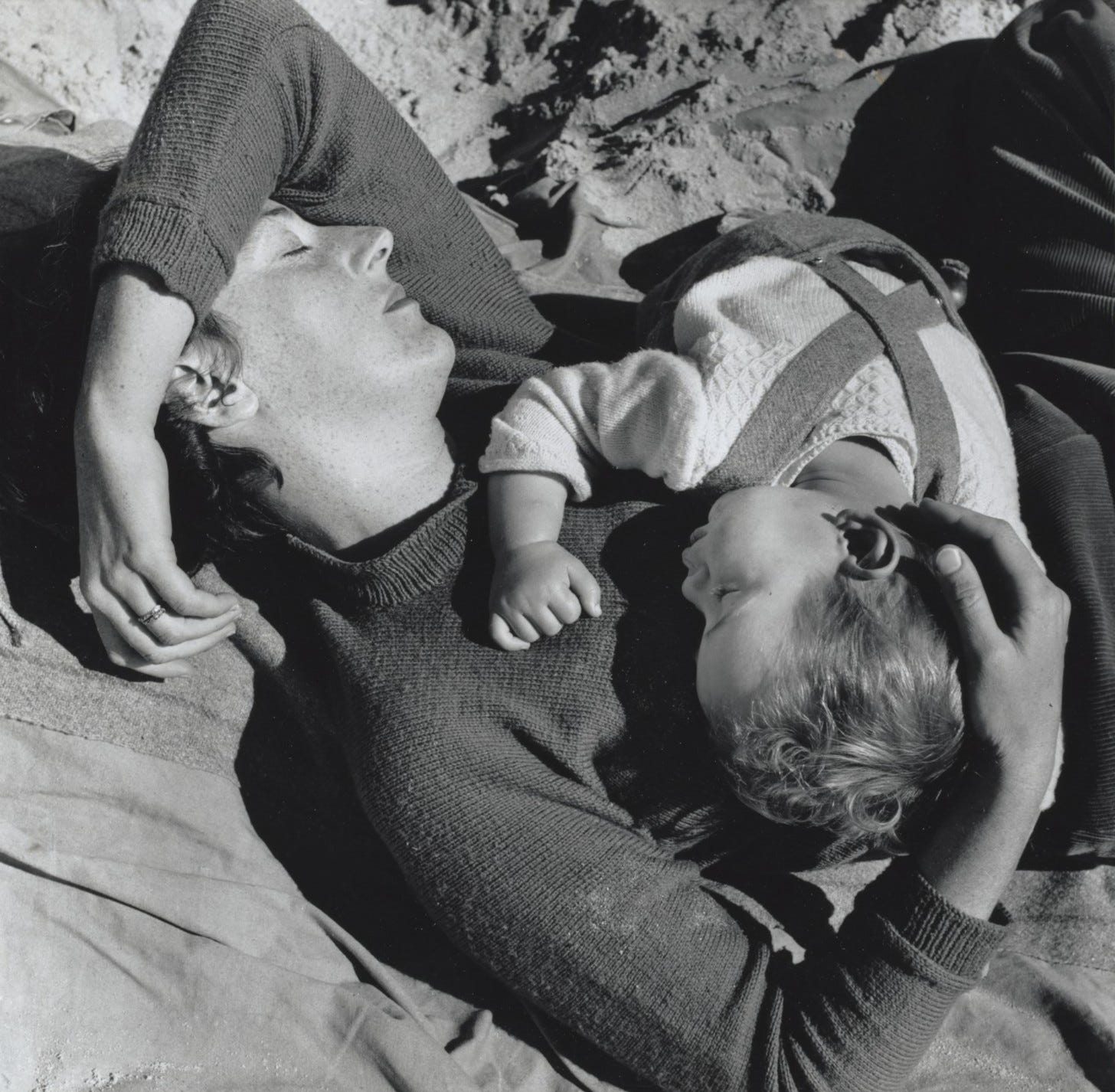
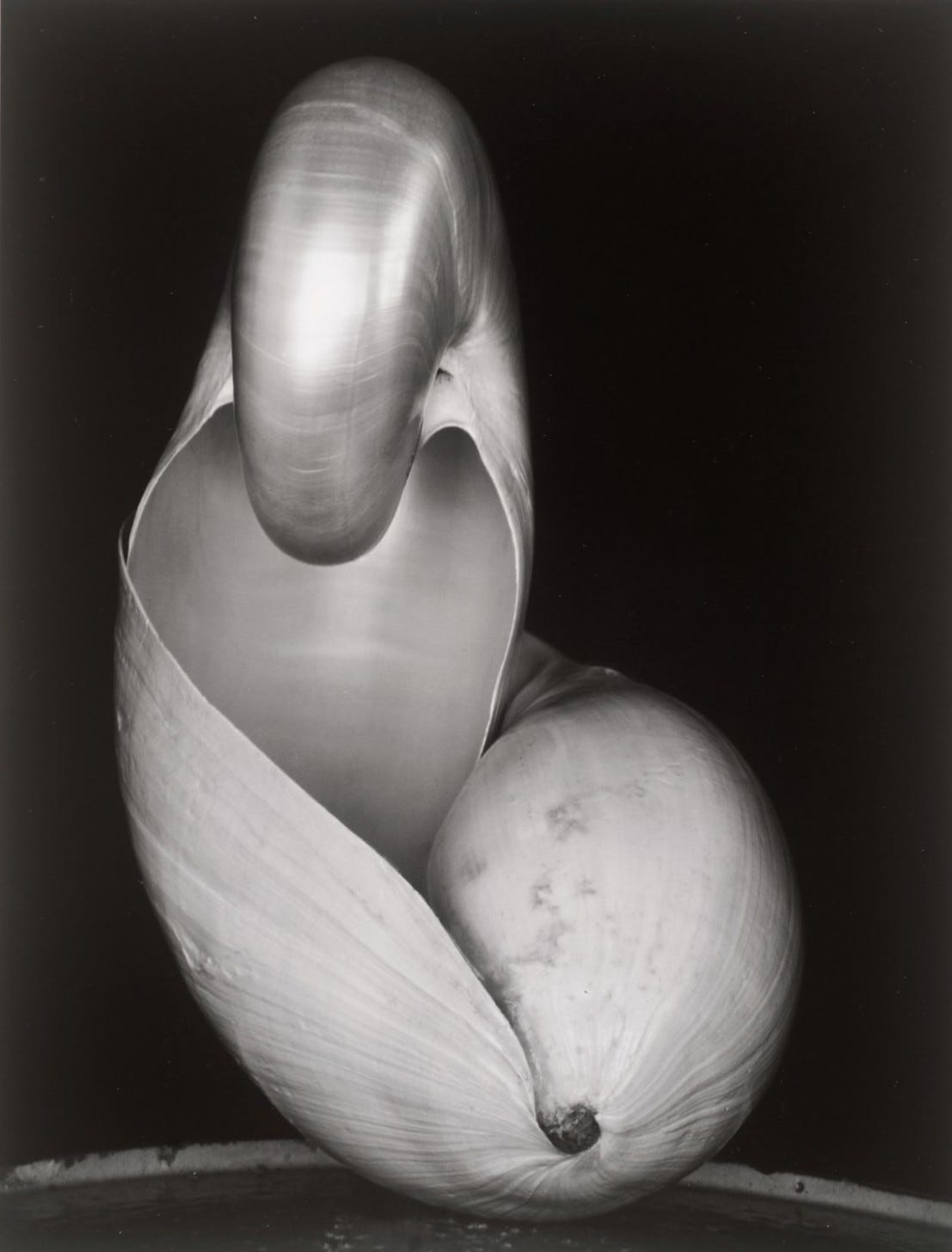
You can find more images from Light and Magic in an online Guardian gallery and an article in the British Journal of Photography.
Fan Ho and Saul Leiter
One of the artists whose work is often described as pictorial – and his pictures are exhibited in the Light and Magic exhibition – is Chinese photographer Fan Ho. He is perhaps best known for his photos of Hong Kong, and he was happy to wear the pictorial label: he called his 1956 photograph ‘As Evening Hurries By’ the “brainchild of my pictorial photography series”.
Looking through the online galleries of Fan Ho’s work, I was struck by their similarity to the work of another photographer I admire, Saul Leiter.
Saul Leiter’s work is often described as pictorial too, but his feelings about this make the definition even more opaque.
“But whenever people referred to the pictorial nature of his photographs, he would be sure to remind them of this fundamental difference: ‘Photography is about finding things. And painting is different, it’s about making something.’”
– Emmanuel Bacquet on The Darkroom Rumour
So we have two photographers, one who embraced the term ‘pictorialism’, one who rejected it. See what you think.
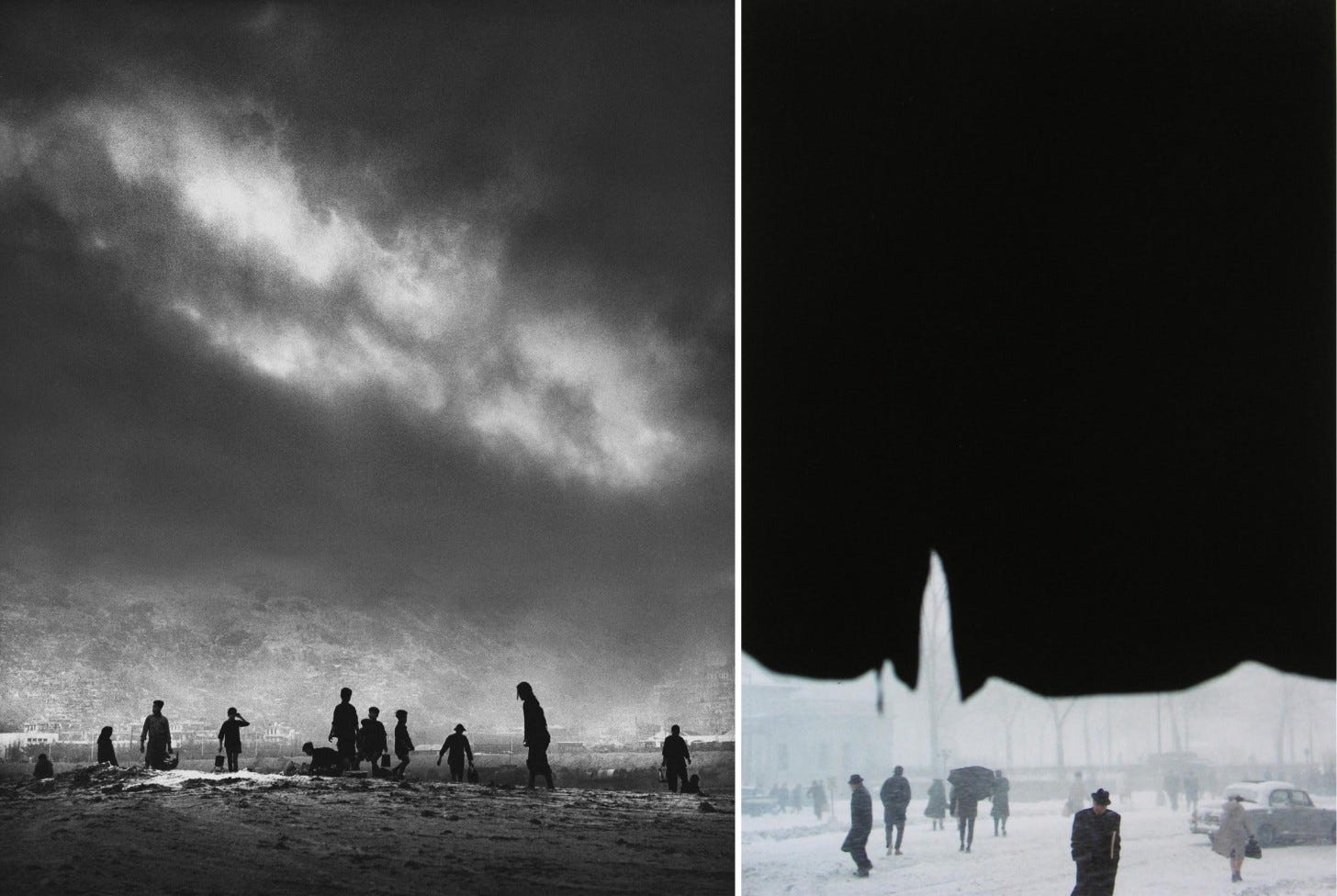
Fan Ho’s ‘Storm Approaching’ is what first made me think of Saul Leiter. Dark clouds fill four-fifths of the frame, with small figures at the bottom. In Leiter’s ‘Canopy’, an almost black shop canopy fills the same proportion, with small figures in dark coats beneath.
Even if you’re not familiar with Fan Ho’s work, you might still recognise ‘Approaching Shadow’ with its strong diagonal shadow and lone figure on the left of a frame dominated by an expanse of white. In Saul Leiter’s untitled photo, similar elements appear: strong diagonal lines directing our attention to a solitary figure against a white background.
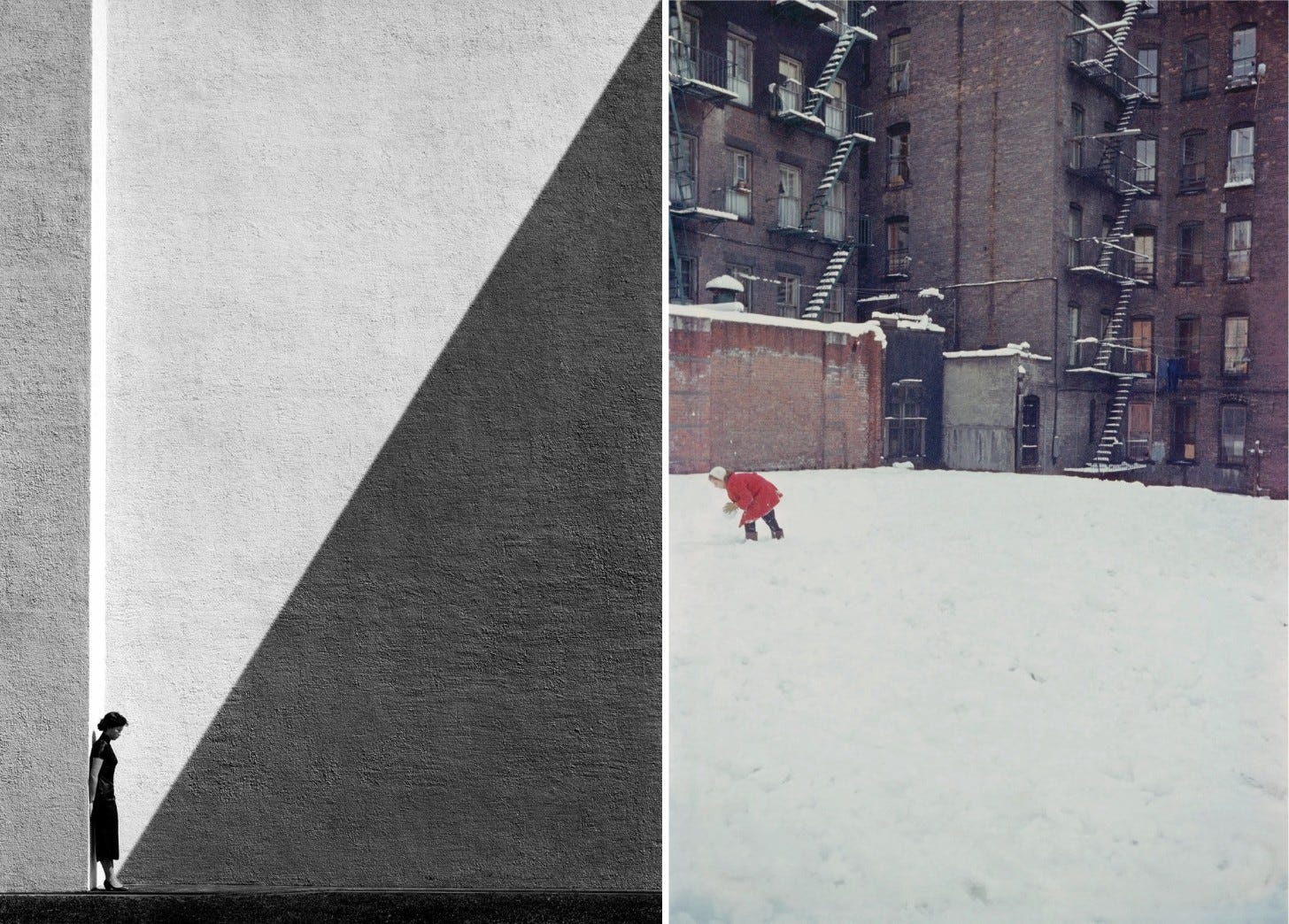
In the course of writing this edition I discovered something that I would have preferred not to have learned. Here’s Fan Ho speaking about the process of making his ‘Approaching Shadow’ picture:
“I made the composition first, and then I finished it by bringing in the triangular dark shadow in the darkroom. There was no shadow on the wall, actually.”
– Fan Ho in an interview for HK Magazine (2012)
No shadow on the wall! Now I don’t know what to believe.
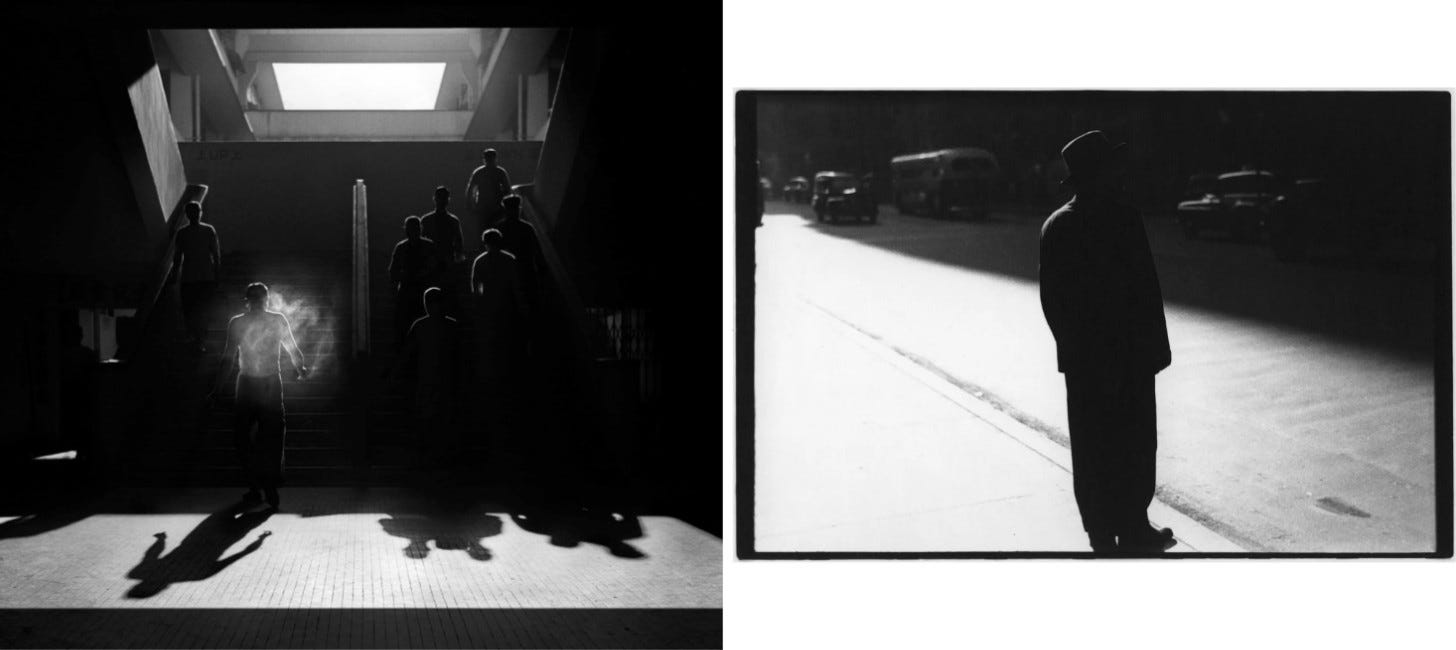
Ignoring that and moving on, Ho and Leiter were both drawn to framing human figures in dominant cityscapes. In both of these pictures we find a composition with large, featureless areas and relatively small human figures walking across the frame.
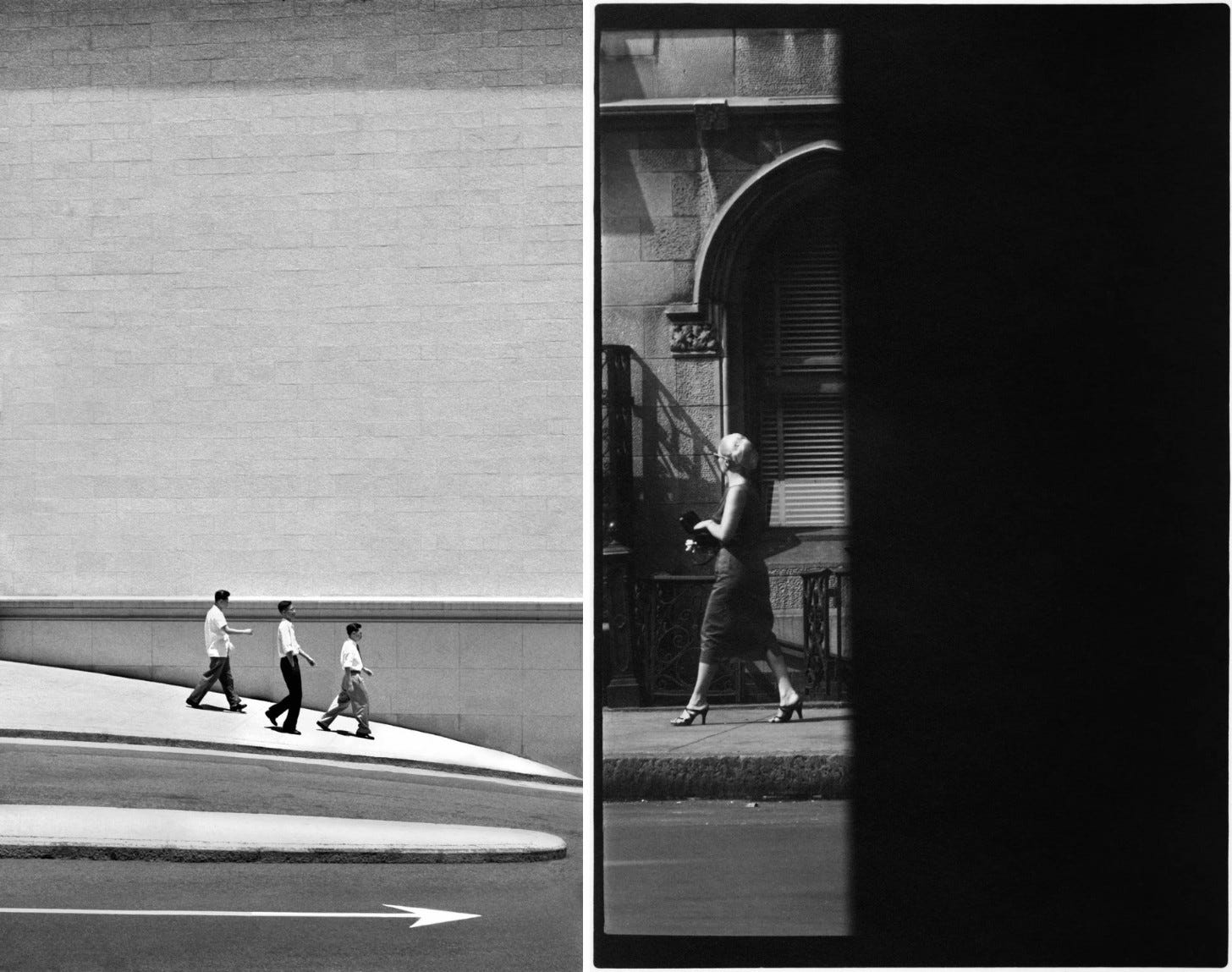
Both photographers were also attracted to photographing directly into strong light, rendering figures in silhouette, with only hints of light describing the shape of a hat, head, or shoulder.
Finally, these two frames might not look so similar at first glance, but they share many qualities: the elevated perspective, strong diagonal lines, and a solitary figure whose burden, a basket in one and an umbrella in the other, tells us a little about the prevailing conditions.
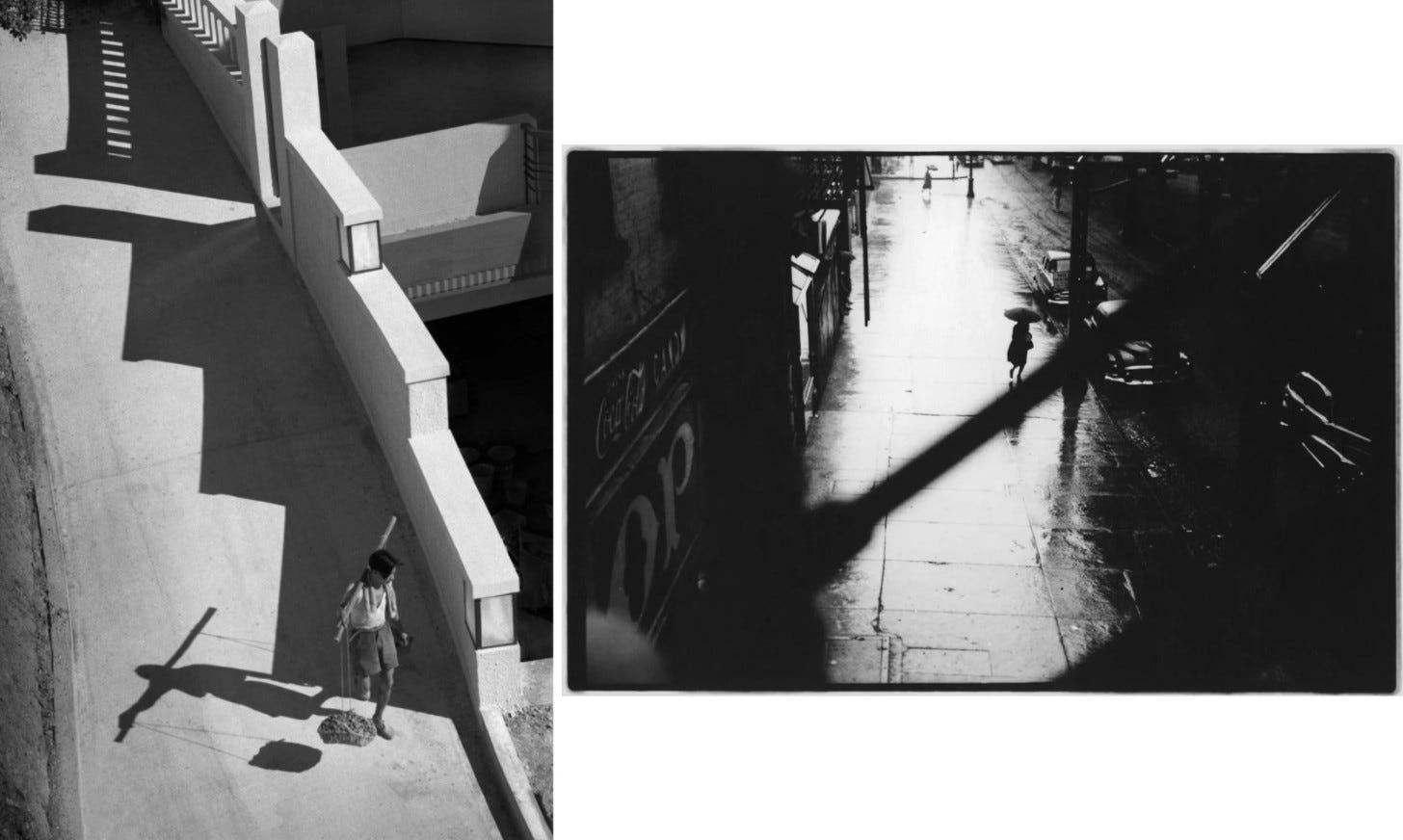
Pictorial or otherwise, I’m a fan of both photographers’ work and I think they share remarkable similarities – even if Fan Ho’s ‘Approaching Shadow’ has lost a little of its magic since I learned that he didn’t find that shadow on the wall but conjured it from his imagination. Perhaps pictorial photography permits that kind of manipulation, which might be good news for Steve McCurry.
Should I ever meet another photo editor who boldly states, “Aha! So you’re a pictorial photographer,” I will say “No” – although I will be no more confident in my answer than I was thirty years ago.
We live and learn. Sometimes.
Light and Magic – The Birth of Art Photography exhibition continues at Tate Modern in London until 21 February 2027.
“In the context of a world where we are surrounded by noise, information, communication, over-information, over-communication, 24 hours a day, 360 degrees; when you get one person saying one thing in a considered way something that they’ve really thought about and taken time to write and rewrite and rethink and then they present that as a quiet page or a spoken poem, I think that’s vital these days. I think it’s a vital redress to the life we are otherwise living.”
– Simon Armitage speaking with Simon Stephens on the BBC Radio 4 programme, Only Artists.
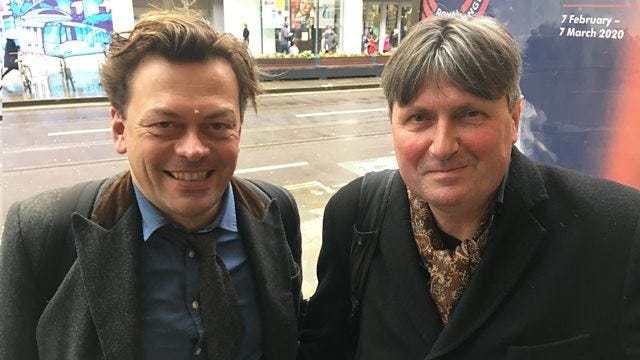
Only Artists was one of those BBC radio gems that deserved a wider audience. It featured two creative people having a chat. No presenter, no pre-prepared questions, no agenda. Authors, poets, playwrights, artists, photographers, sculptors, comedians, and more, just chatting about life, work, opportunities, creativity, destiny – and occasionally hearing aids.
The Wider Angle
Avedon on Netflix
Fans of Richard Avedon may be renewing their Netflix subscription in order to watch a new documentary by Ron Howard about the celebrity photographer’s life and work.

I’ve yet to see the film, but the reviews are glowing. Not least Owen Gleiberman, writing in Variety, who enthuses, “Woven through the movie are hundreds of photographs that were shot by Richard Avedon, and there’s no question that the images are stunning, but the way the movie layers them into your consciousness is nearly musical in its finesse.”
Print Swap
Photographer Sam Faulkner has developed Print Swap, an innovative app that allows photographers to swap prints with fellow photographers.
I learned about Print Swap from an article in the British Journal of Photography. Echoing something I’ve written about on many occasions, Sam says “We’re surrounded by more images than we’ve ever seen. How much attention do we give them when they’re 4cm x 4cm on your screen? You literally just swipe past them, and they become completely disposable.”
The concept is simple: photographers post a selection of their images on the app and, if another photographer sees one they’d like to own, they offer to swap for one of their prints. If both agree, each pays to have their own print made, Print Swap organises a professional lab to make the prints and they’re sent to each recipient.
Most photographers I know enjoy collecting prints from photographers they admire and Print Swap provides an opportunity to collect images that we’d like to hang on a wall without having to pay big gallery mark-up prices.
If you sign up with Print Swap and succeed in swapping prints I’d love to hear about your experience. Let me know.

Print Swap is available for iPhone on the App Store.
And finally…
Competition Winner
Thank you to readers who left comments on last week’s edition, especially to James, whose name was pulled from the hat. A shiny new copy of the Leica Oskar Barnack 2026 Special Edition book will soon be landing on his doormat.

The Darkroom Rumour Special Offer
If the Richard Avedon documentary on Netflix appeals, you might also enjoy the growing library of photography documentaries available in The Darkroom Rumour archive.
One recent addition documents the work of Allan Baldwin, a photographer who “travelled across Aotearoa New Zealand, meeting and photographing elderly Māori women who wore the moko kauae, the traditional tattoo of the chin. At a time when this ancestral practice had become increasingly rare, his journeys resulted in a remarkable series of portraits.”
Reminder: all Founding Member subscribers to this newsletter receive perks, including six months’ paid subscription to the complete Darkroom Rumour archive.

I hope the coming week provides you with the time and energy to discover some moments of creative inspiration, pictorial or otherwise.
Go well.

✤ Creative Inspiration
Lateral-thinking prompts, inspired by Brian Eno’s Oblique Strategies, designed with photographers in mind.

Read more and learn how to use my Creative Strategies for Photographers.

Well, thank you for two things:
1. Validating my own inability to offer an opinion on what pictorial photography is or is not. I think, like Iris DeMent, I'll just "Let the Mystery Be".
2. I was horrified to read that the Fan Ho photo with the diagonal shadow, done in 1954, was a darkroom creation. All of us who have ever worked in darkrooms know that what emerges on a print is rarely just a straightforward transfer from neg to print. But this photograph presages by 75 years, almost, my current concern about not being able to differentiate between an image produced by AI from a prompt and an actual image. I guess my conclusion on this, now echoing Cormac McCarthy, is that the world has become "No Country for Old Men". :-D
Welcome back. Say hi to Madame Gough.
Oh, how I wish I were going to be in London before 21 Feb 2027 and could see this exhibition in person! Alas, it is not to be.
And so I was pleased to be able to read your account of pictorialism in terms of your personal encounters with it and to see some of the astonishing photographs included in "Light and Magic".
The Tate offers its own definition of this elusive term, as you likely read: "Beginning in the 1880s, pictorialist photographers worked to create images that were as imaginative, expressive and technically considered as any painting or drawing."
As someone trained in the history and theory of the cinema, the timing of the pictorial photography movement (?) intrigues me, because it overlaps with the often-discussed “Lumière/ Méliès Dichotomy” of the late-19th and early 20th centuries. In sum, that dichotomy encapsulates the tension within early filmmaking between documenting reality (e.g., the Lumière brothers films of the 1890s) and fabricating reality (e.g., Georges Méliès's TRIP TO THE MOON, 1902).
Are these dichotomies unique to the 19th century? Probably not, but the possibility of the "mechanical reproduction" of reality certainly brought them into sharp focus, shall we say. (Apologies to Walter Benjamin.)