

Where Two Rivers Meet
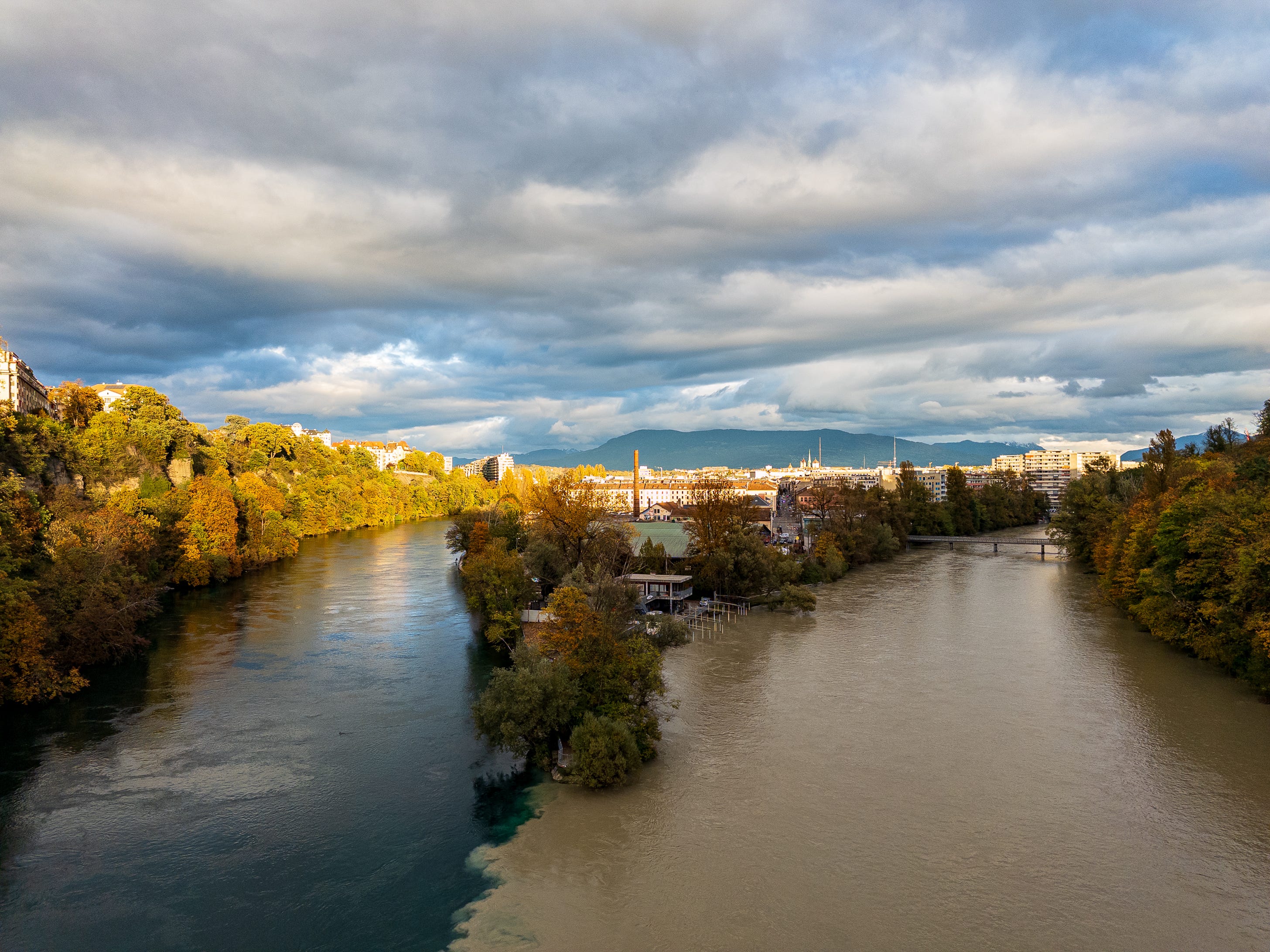
If you visit me and my wife in Geneva – and you’re always welcome – after what’s likely to be a modest but tasty dinner, we might suggest a walk to the river.
We’ll probably reach the Pont de la Jonction – a railway and pedestrian bridge – around dusk and we’ll look down upon the confluence where two rivers meet.
On the left, the Rhône is pale turquoise and reaches us after settling its turbulence in Lake Geneva, a few kilometres upstream. The lake acts as a vast settling tank. By the time the water flows out of the lake, it is tranquil and clear, unhurried and placid. On the right is the River Arve, which is sometimes blue, but often the colour of milky tea or mud-covered gold. The Arve is fed not by the lake but by glaciers on the flanks of Mont Blanc. Glacial ice doesn’t simply melt into water, it grinds the bedrock beneath it, forming a river that is rich with ancient sediment. The Rhône is clear and measured, the Arve is turbulent and restless.
And no, you won’t be the first guest to wonder aloud whether the characteristics of these two Swiss rivers reflect the personalities of your husband and wife hosts. You probably think you’re funny…
At the point where the rivers meet, they have such different densities and temperatures that they run side-by-side, maintaining their separate identities for a few hundred metres, before gradually, inescapably blending into one.
Our two-rivers walk has become an unceremonious after-dinner habit. We always instinctively pause above the rivers’ meeting point and the scene is different each time. The Rhône is remarkably consistent, the flow controlled by sluices at the southern edge of the lake. The Arve is more changeable, like wet concrete whenever there’s been rain in the mountains or in warmer weather when the glacial melt is accelerated.
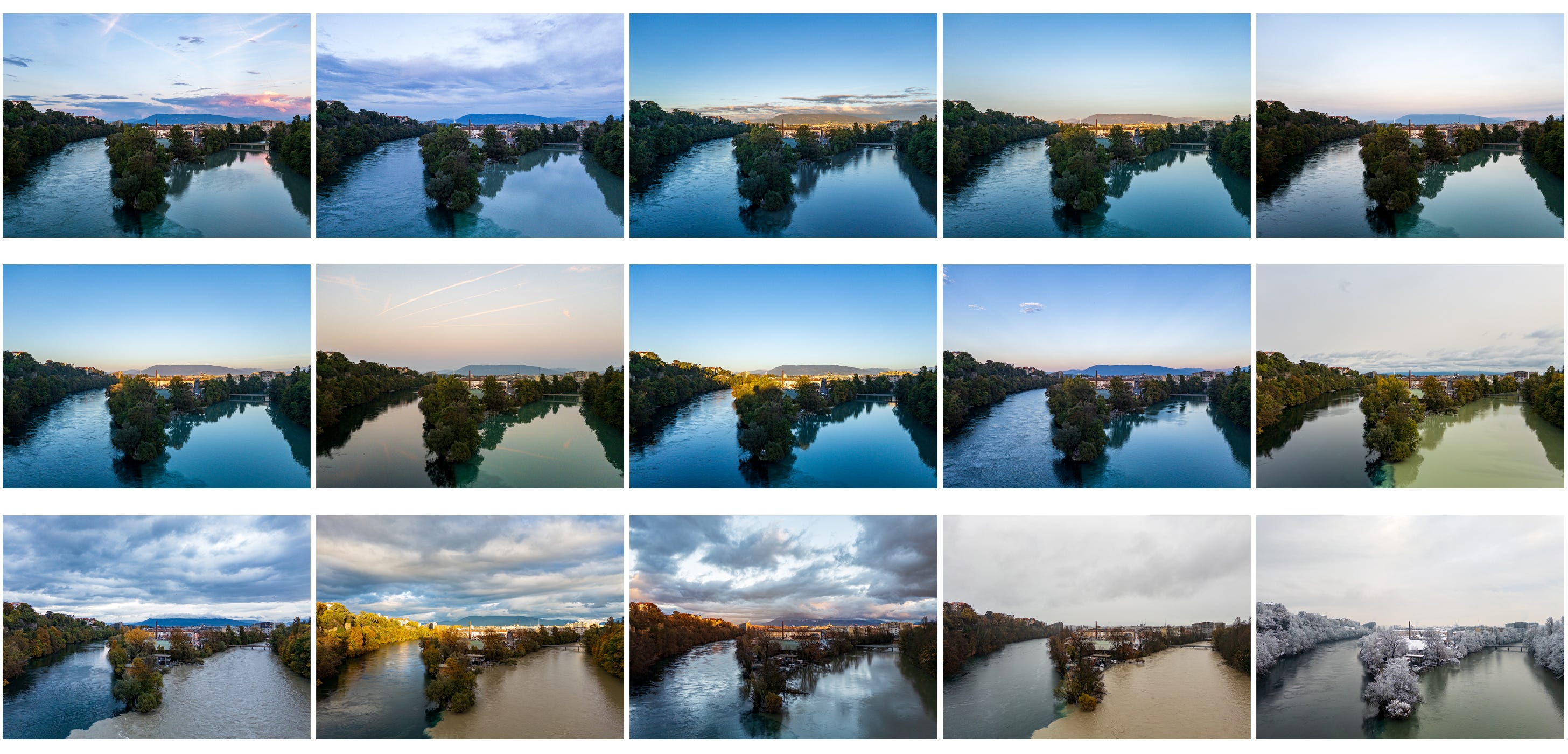
I make a photo each time we’re there, typically just with my phone. It’s an ordinary act, done almost in passing. The photos reflect the variety of the scene. Some days are flat and grey, others are clear and blue. Autumn colours give way to bare branches and then to snow-covered monochrome.
None of this is surprising or dramatic. It’s a bridge, two rivers, a distant city skyline, an evening walk. But that’s rather the point. Familiarity with a place doesn’t force it to become static. Rather, it allows us to see what changes. And in that act of noticing, we’re reminded of time passing, seasons changing and months becoming years, years growing into a lifetime.
Looking upstream towards Geneva, whatever the weather and however rambunctious the Arve is being, the same thought always comes to mind: “This scene will never look the same again as it does right now.” As you’re drawing your own existentialist conclusion from that, here’s a small selection of pictures from the bridge.
I’ve also been making a photo each day of an impressive Horse Chestnut tree in our neighbourhood. Its unremarkable location belies its magnificence. Alone in a meadow it would attract visitors from far and wide, much like the ill-fated Sycamore Gap Tree. But in a suburban setting, beside balconies and above a car park entrance, it’s barely noticeable. Context is everything.
I enjoy photographing the everyday just as much as the extraordinary. Indeed, there may be greater value in finding something noteworthy in the seemingly unremarkable, if for no better reason than the ‘unremarkable’ is all around us all the time. We see the everyday every day. Fortunately, transforming the unremarkable and everyday into objects worthy of our attention only requires a small recalibration of our attention, a conscious gear-shift from neutral to noticing.
Take notice. Be curious. Catch sight of the beautiful. Remark on the unusual. Notice the changing seasons. Savour the moment, whether you are walking to work, eating lunch or talking to friends. Be aware of the world around you and what you are feeling. Reflecting on your own experiences will help you appreciate what matters to you.
– Sophie Howarth from The Mindful Photographer.
Melissa Farlow
Melissa Farlow, a Pulitzer Prize-winning documentary photographer for National Geographic, was the most recent interviewee on the Frames photography podcast.

I am so thankful for podcasts. They represent much of what we originally thought the World Wide Web would bring: An abundance of freely-shared, entertaining and educational material made by people with a passion. Podcasts are the antidote to social media.
This week, I listened to Melissa Farlow’s interview and am embarrassed to realise that I’ve neglected to share her work before. I’m remedying that oversight now.
Melissa describes how she made the photo of novice nuns playing volleyball (above) the day before her official visit to a convent in Arequipa, Peru – and shares a reminder about the importance of always carrying a camera.
“Thank goodness I had my camera with me. I always carry a camera because I want [people] to know I’m a photographer. I heard laughter… I saw these young women with a ball… and it was beautiful light, and it was just an amazing scene, and there were only five or six girls, and they were laughing, and they were shy, but they were playing. I thought, wow, this is going to be fantastic tomorrow.”
– Melissa Farlow (50:58)
Anticipating even more photo opportunities the following day on her official visit, Melissa was understandably excited to return to the convent.
“It was horrible the next day. Everyone was expected to be following the rules and they were ironing and they were doing work and it had none of the spontaneity I had seen the day before.”
– Melissa Farlow (51:55)
Photography assignments rarely pan out as we expect but it’s often the unplanned moments which yield the most memorable moments.

Melissa also speaks about a formative project, photographing mothers in prison. She speaks about how the project evolved, changing from what she had anticipated into something more closely aligned with what she actually found. What she says echoes my own feeling about the value of familiarity.
“As time went on and Phyllis got out of prison, I realised that my idea of the story was fixed. It was through my point of view. And so it made me realise that I was telling her story. And I think the only way you can do that is to continue to return to a situation, to understand it, and let it evolve in a natural way, and to be sensitive to what the points and the moments are. They’re meaningful in that person’s life.”
– Melissa Farlow (36:07)

“I’m at the period of my life where I’m looking through archives. I’m looking through old photographs and I’m trying to make sense of what my life was about and what it meant and where I was and who I met and all of those things. And what’s amazing to me is how the photograph triggers the reality of being there.”
– Melissa Farlow (09:17)

“My hope is that the next generation will continue this following. I was inspired by many people before me, and I feel it’s important, in their honour, to share what I can and hope that they continue that tradition.”
– Melissa Farlow (1:06:00)
You can listen to Melissa’s interview of the Frames photography podcast and you can see more of Melissa’s work on her website and Instagram page.
“I take photographs in my neighbourhood. I think that mysterious things happen in familiar places. We don’t always need to run to the other end of the world.”
– Saul Leiter
The Wider Angle
A Century of American Photography
One hundred years of American urban life. From New York to Los Angeles and Boston to San Francisco, this exhibition features many era-defining photographs.

Saul Leiter, Dorothea Lange, Diane Arbus, Richard Avedon, Mary Ellen Mark… it’s a roll call of the most renowned photographers.
Both Time Out and The Guardian give the exhibition enthusiastic four-star reviews.
Portrait of a City: A Century of American Photography is open now until 4 October 2026 at the Dulwich Picture Gallery in London.
The Keith Armstrong Collection
My favourite story of the week is about disability-rights campaigner and amateur photographer Keith Armstrong.

Keith photographed protests, pickets, blockades and direct action events from his wheelchair.
His archive of hundreds of images was only discovered after his death. Given the under-reporting that disability-rights protests attract, Keith’s archive is an important social document.
The digitised collection now resides at the National Disability Movement Archive and Collection. All of Keith’s photos are free to use in exhibitions, books and on social media.
Looking at Keith’s images, you appreciate how he used his unique viewpoint to make images with intimacy and immediacy. He photographed from within, not as an outside observer on the fringes.

Keith’s pictures are a reminder that the best perspective is often held by those on the inside of a story. They’re also a great example of how consistent work on a theme can produce a meaningful body of work. The sum of Keith’s work is certainly greater than the sum of its individual parts.
And finally…
Following my less-than-enthusiastic review of The Odyssey – the Christopher Nolan blockbuster that’s currently setting box office records – an update: My wife, who’s currently away from home, saw the film yesterday and thought it was excellent.
Interestingly, we said almost exactly the same things about the film yet our conclusions were quite different. One of us noted the impressive size of Matt Damon’s biceps, which, apparently, is a point-scoring plus.
No doubt he’s been working out in expectation of lifting that heavy Oscar statue next year.
I leave you with this recently-discovered excerpt from Homer’s original text:
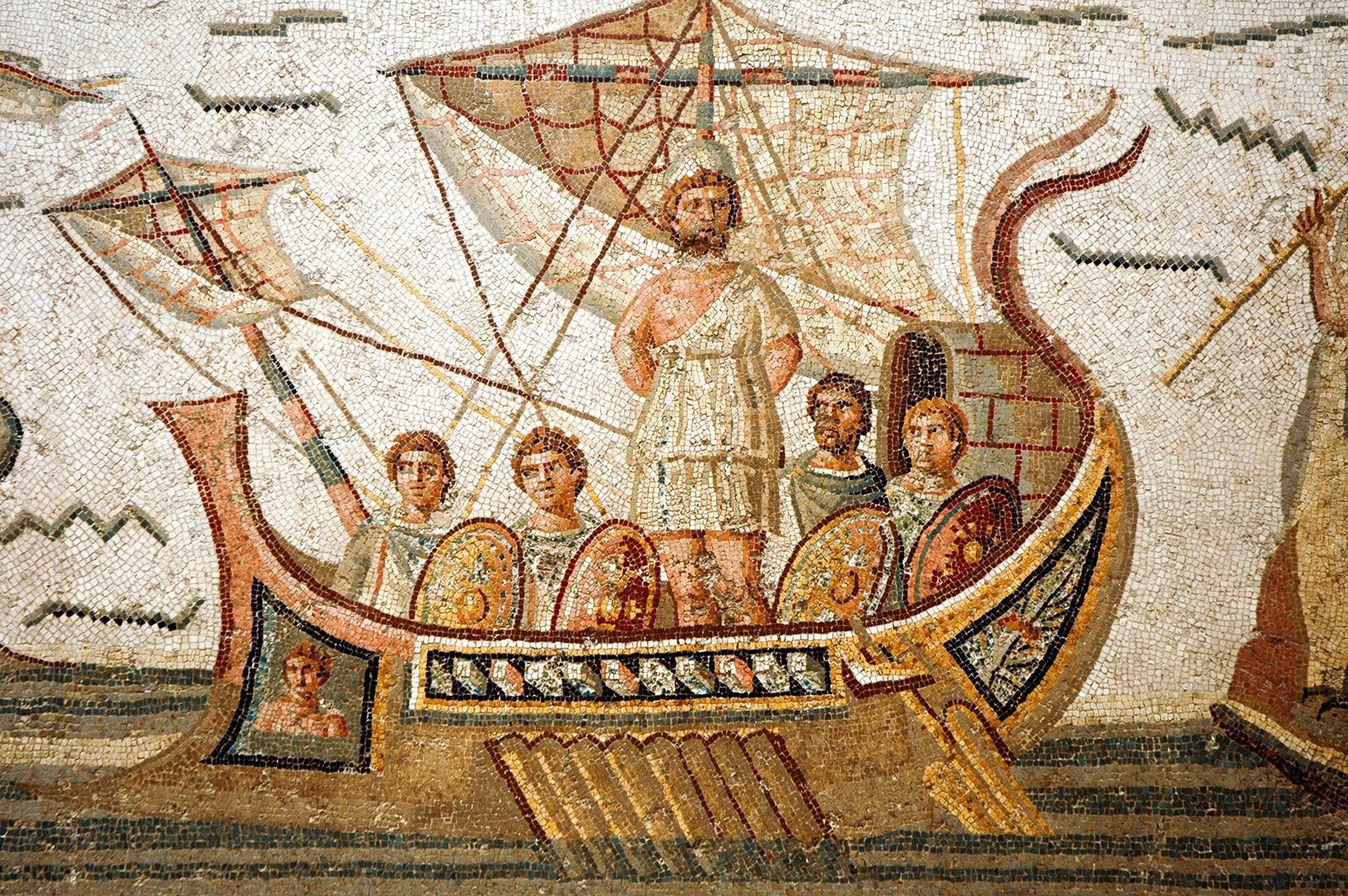
Odysseus: “We set out now upon our magnificent odyssey”
Sailor: [Raising hand] “What is an odyssey?”
Odysseus: “It’s a long journey named after the only survivor.”
Sailor: “Oh. WAIT! WHAT?”
May all your odysseys be magnificent.
Go well.

✤ Creative Inspiration
Lateral-thinking prompts, inspired by Brian Eno’s Oblique Strategies, designed with photographers in mind.

Read more and learn how to use my Creative Strategies for Photographers.

There's much to appreciate in this post, Gavin--from your lovely photographs of the Rhône and Arve confluence to your introducing me to Melissa Farlow's (!) and Keith Armstrong's work.
I found Farlow's images to be particularly striking--inspiring me to shift from reading your post in Gmail to seeing the images in a larger format on my computer. How on earth did she capture "Cowgirl Heidi Redd"? The action is amazing and the lighting is spectacular--with her whip arcing up toward the sun. Was Farlow following Redd on horseback??? That might be the most amazing photograph I've seen in 2026.
Wow, just, wow!
“there may be greater value in finding something noteworthy in the seemingly unremarkable, if for no better reason than the ‘unremarkable’ is all around us all the time” - with this quotation from your article I must say that yesterday I’ve visited the amazing We Are Martin Parr exhibition. Isn’t it all about this?