

Solar Halo
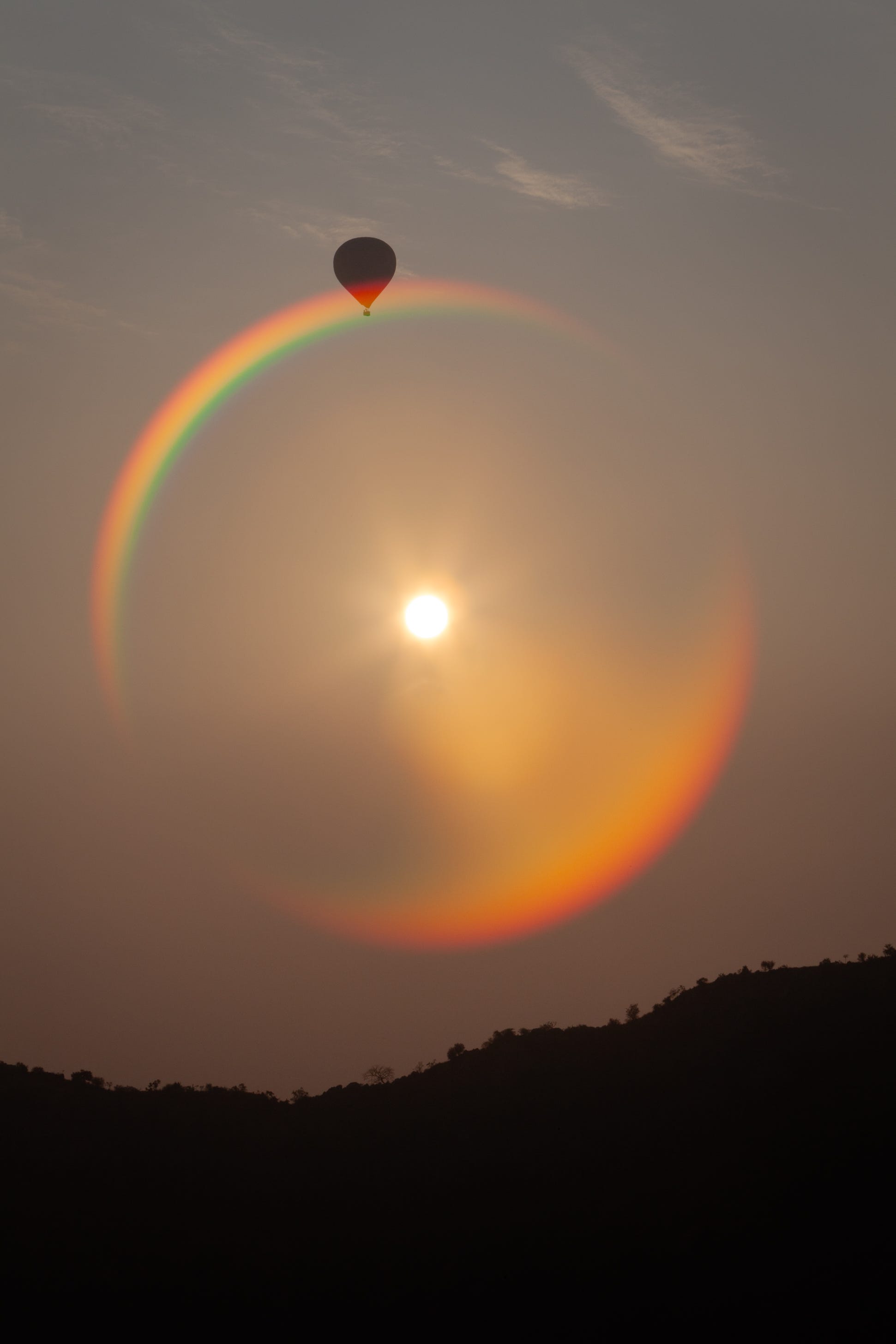
The most memorable images from a day’s work are often the ones that couldn’t have been planned. These unexpected moments tend to linger with the greatest clarity.
Pushkar
It’s early morning in Rajasthan – far too early to be civilised. Peeking through the door of my tent, I see a blanket of grey overhead. There’s a promise of a ride in a hot-air balloon if I can get to the other side of Pushkar before breakfast. But the light is dull and flat, hardly inspiring. In that moment, retreating to the comfort of my bed is the most tantalising prospect.
Still, I’m up now. Might as well make the most of the day. One never knows what rewards might be in store for an early-riser – even a reluctant one.
One hour later I’m standing in a large wicker basket, the twin burners are roaring flames, and we begin to float skyward.
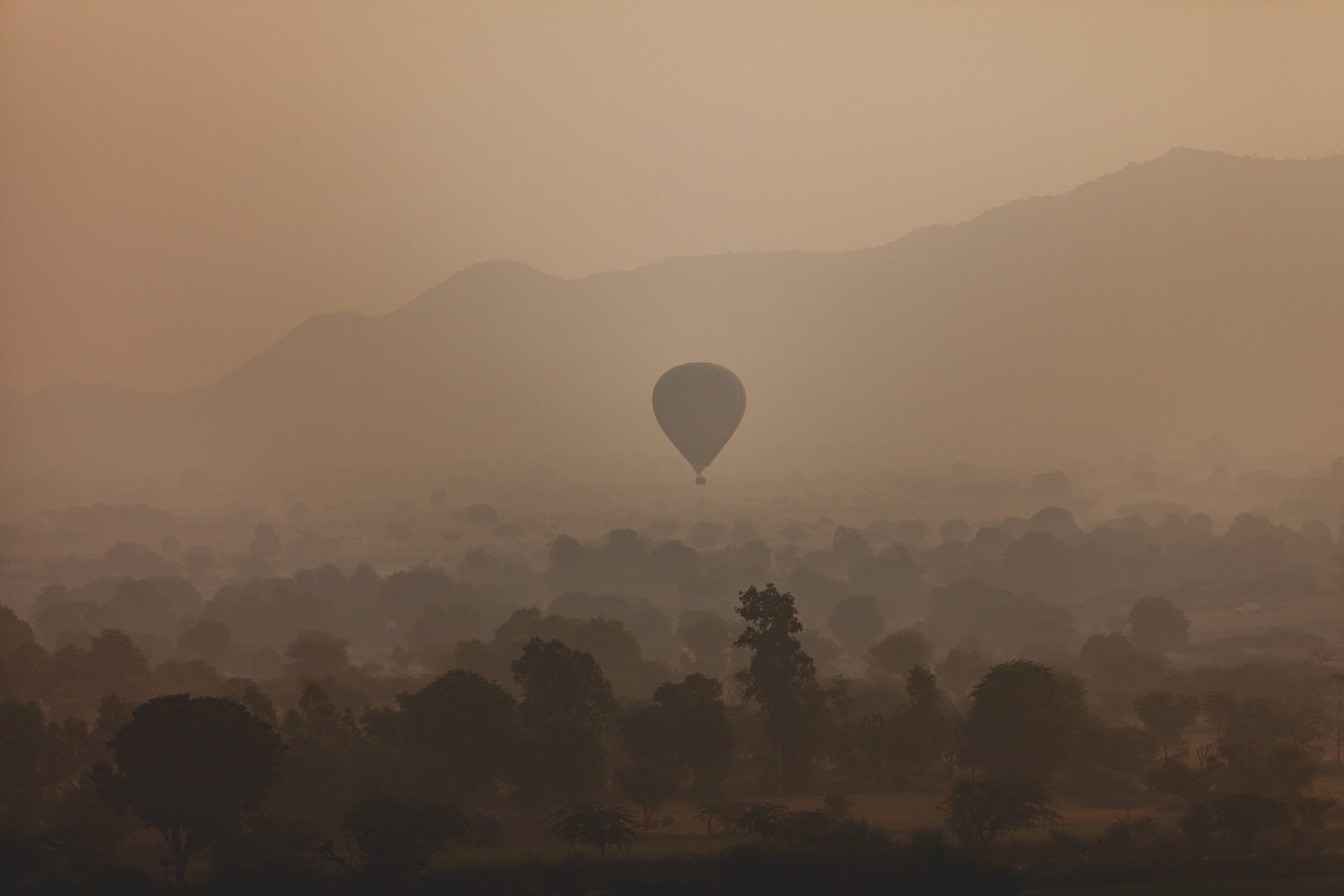
Although the sun has risen, its light is diffused by clouds of dust and sand. There’s little contrast and the long, sharply defined shadows I’d seen in my dreams won’t appear for many hours, long after we’ve landed.
Nevertheless, there’s something about an elevated view of a landscape that shifts perspective, physically and emotionally. The ground-level busyness of tents and camels is reordered into punctuation marks upon a page of ochre sand.
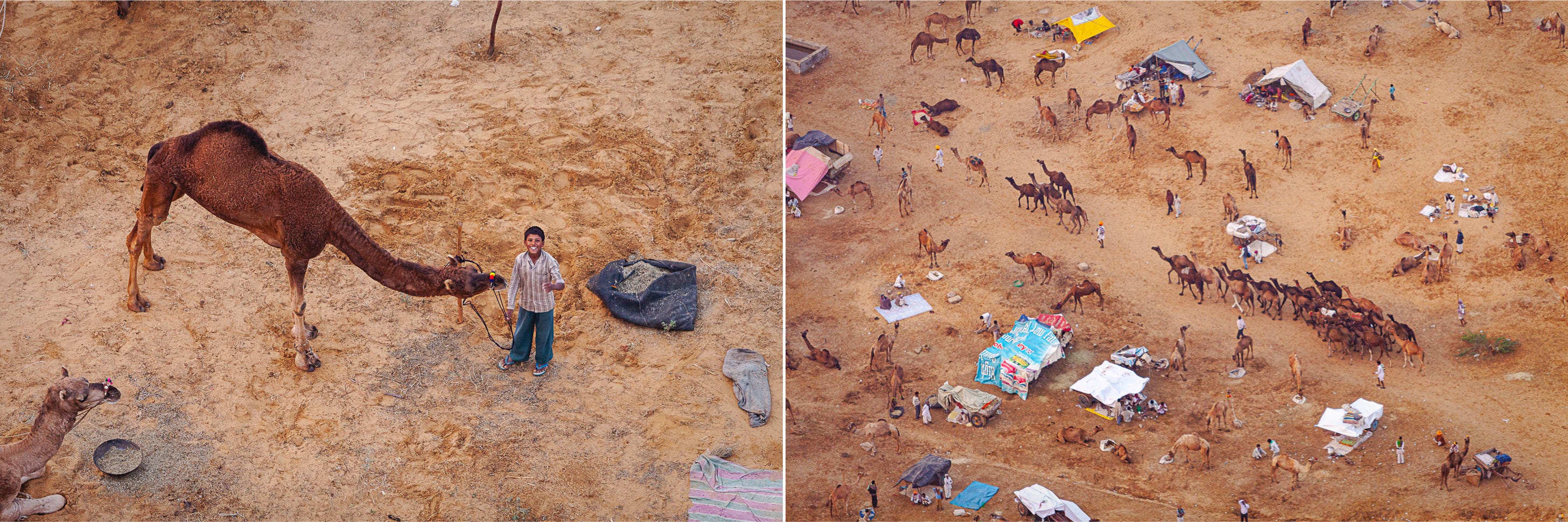
I adjust my expectations – as one learns to do – and begin to appreciate the unusual geometries afforded by our elevated perspective.
And then something appears in the sky that I have never seen before, and may never see again.
Low above the hills to the east, the sun has shrunk to a narrow disc behind a gauze of dust. Around it an almost perfect circle of colour.
I’ve seen pale, wintery solar halos before. But this is a full, saturated spectrum: from deep red through amber and green to purple and electric blue.
Twenty-two degrees across, perfectly centred on the sun, solar halos form when light passes through ice crystals suspended high in the atmosphere, bending the light at exactly the right angle to project colour towards the observer.
Full spectrum solar halos are rare. Rarer still to see another hot-air balloon floating towards the circle of colour. There was little I could do to control our position relative to the other balloon so I could only will it to float closer to the halo. Our pilot sent a burst of flames into our balloon’s canopy and we climbed a few metres, just enough to reach the perfect elevation. As the halo resolved fully, the other balloon descended and I had time to make a single frame.
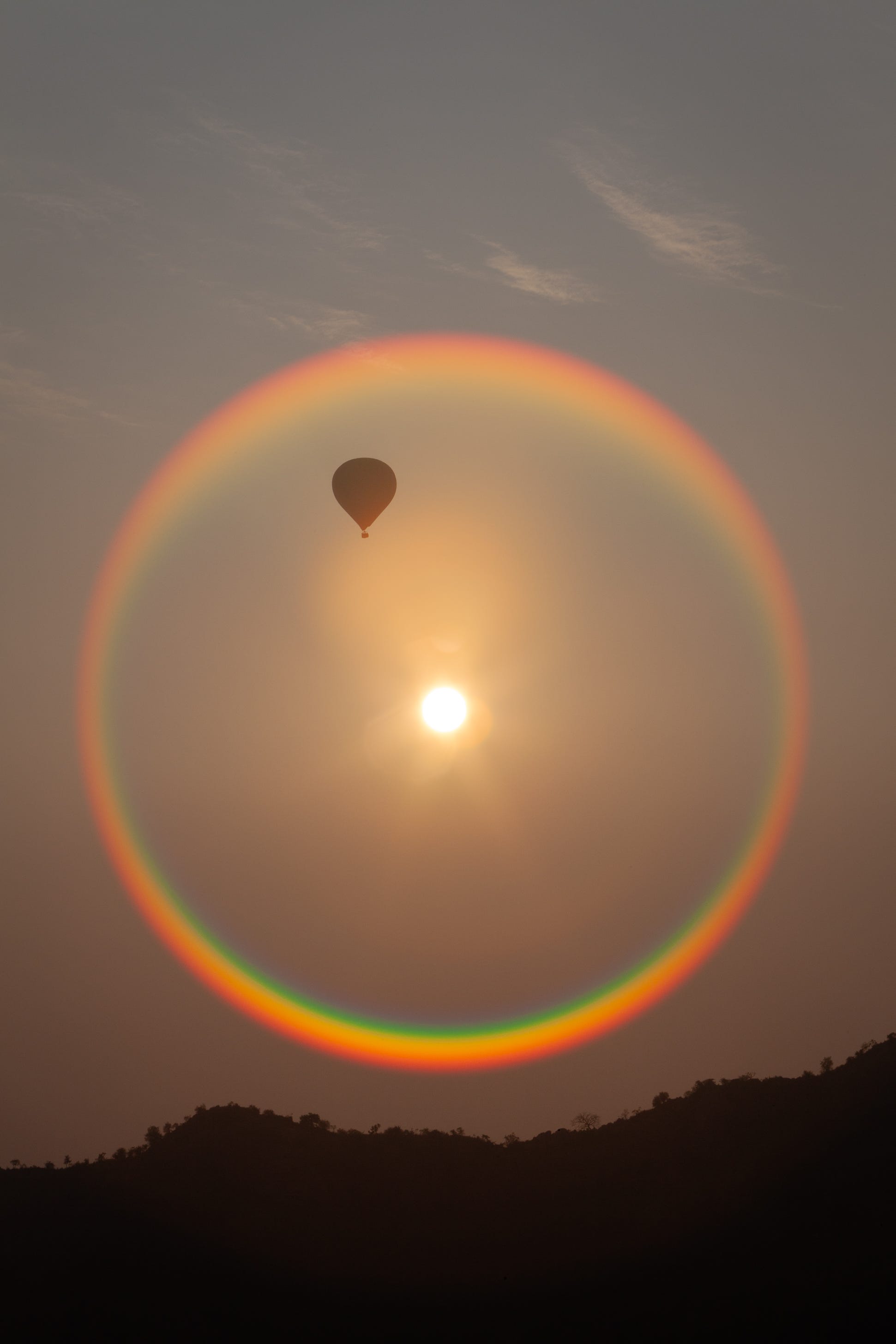
As is so often the case, photographic craft and technical experience had little to do with the making of this photo. Yes, I stopped the camera’s aperture down to ƒ/32 to give the halo definition but that’s not critical. Opportunities like this arrive when you’re willing to get up before dawn, to stand in flat light, to keep working even when it seems like the images you expected aren’t coming.
World Press Photo 2026 Winners
The winning images for this year’s World Press Photo contest have been announced. In a year that was arguably more turbulent than any other in recent times, there’s much to see in the galleries of selected photos.
“This is a critical moment – for democracy, for truth, for the question of what we as a society are willing to see and call out and what we are willing to ignore. The photographers recognised here have done their part. They have made the record. Now it is our turn to look.”
– Kira Pollack, 2026 World Press Photo contest global jury chair
I’ve selected just three images from a diverse range of stories, each of which is deserving of our attention. These three photos had the most immediate impact on me but many others illustrate stories that don’t always make the headlines. Exploring the galleries of winning images has introduced me to many stories that I was not previously aware of.
Hong Kong

I will be surprised if Tyrone Siu’s photo is not chosen as the overall World Press Photo of the Year. The official announcement will be made later this month (April 2026).
All the essential information is contained in the frame: the scale of the physical destruction, the intensity of the human anguish, and the connection between the two. It brings us into the heart of that terrible event and allows us to see – and feel – Mr Wong’s pain. For me, it does what the best photojournalism aims to do: it brings an aspect of the human condition into stark reality and gives us pause to consider a universal truth – the intense pain of profound loss.
Argentina

There’s something biblical about Tadeo Bourbon’s image from a protest against Argentinian austerity measures. Swap the kevlar body armour for plate metal and the batons for spears and it could have been painted by Caravaggio.
Colombia

A young Ferley Ospina and his mother were forced to flee after Ferley’s father was murdered. Now a photographer, Ferley has photographed the women in his family – including five-year-old Valeria – to explore what he calls the “weight of absence” in a community where almost one-third of families are headed by single mothers.
Perhaps it’s a stretch on my part but I strongly suspect that the most sensitive, most considered images are often born of the most personal stories.
World Press Photo 2026 Winners’ Gallery
You can find the full collection of winning images on the World Press Photo website and highlights in a gallery on The Guardian website.
World Press Photo almost always lists the make and model of the camera used to make each image. My quick, unscientific review suggests that full-frame cameras are still the most popular, with a few smaller Fujifilm and drone cameras making an appearance. A complete analysis is perhaps a task ideally suited to AI.
The World Press Photo exhibitions are constantly touring and there’s likely to be one coming to a town near you.
“We must look at it. We’re required to look at it. We’re required to do what we can about it. If we don’t, who will?”
– James Nachtwey, Photojournalist
Competition Winner
Congratulations to the winner of the competition in Beyond the Frame 92/.
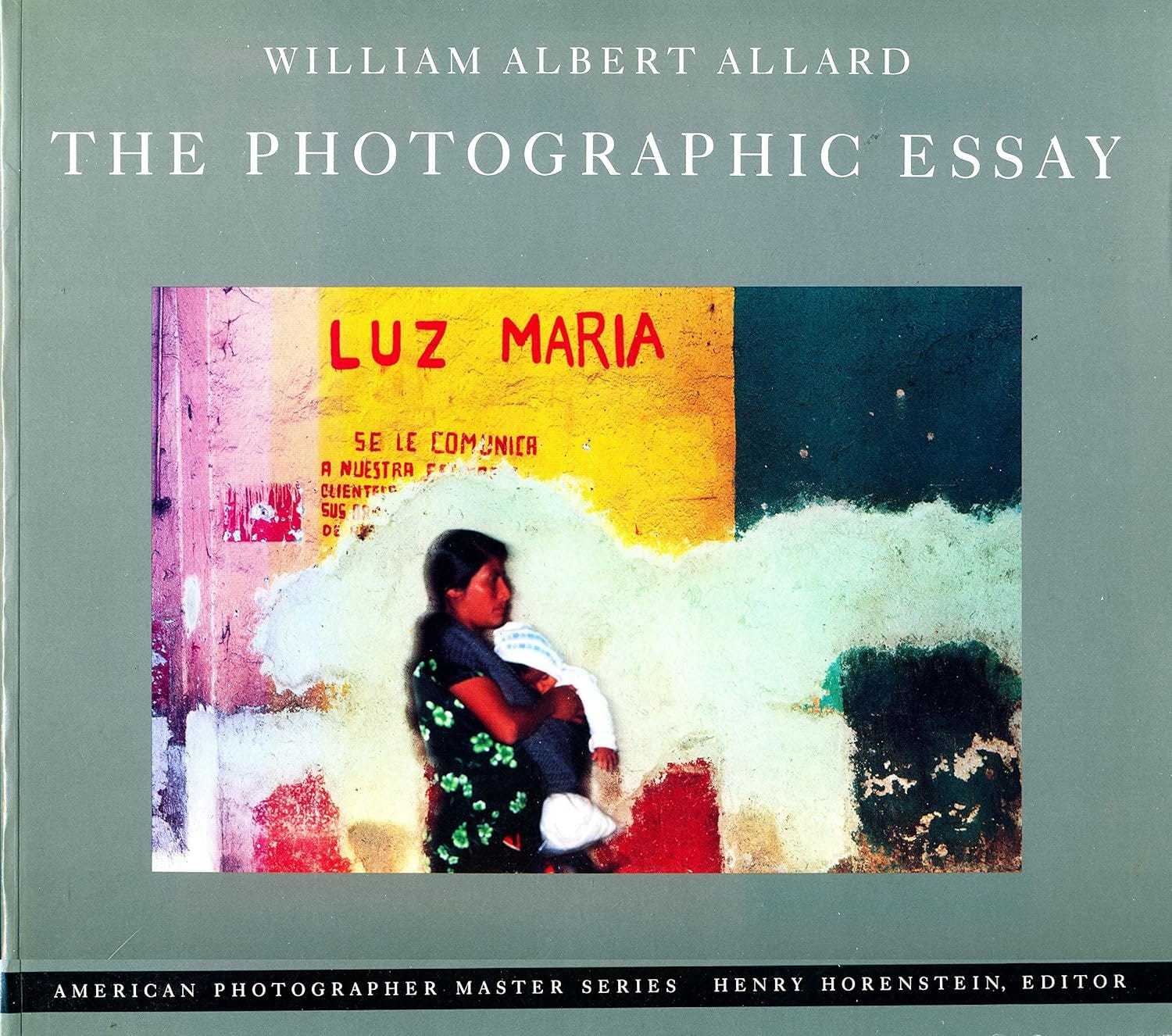
A rare copy of The Photographic Essay featuring the work of William Albert Allard will soon be heading ‘down-under’ to newsletter supporter and competition winner, Janice Johnson, who correctly identified that William Albert Allard was born in 1937.
The Wider Angle
The Taylor Wessing PHOTO PORTRAIT PRIZE 2026 is now open for entries until 21 April 2026.
The National Portrait Gallery’s annual photo contest has consistently highlighted photography that challenges viewers’ expectations. The winning images from 2024 and 2025 are typical examples. I really recommend reading the image captions and descriptions in full.
PALESTINE: Adam Rouhana’s article in the New York Times is over one year old and much has changed since it was published but I’m certain the main premise remains true.
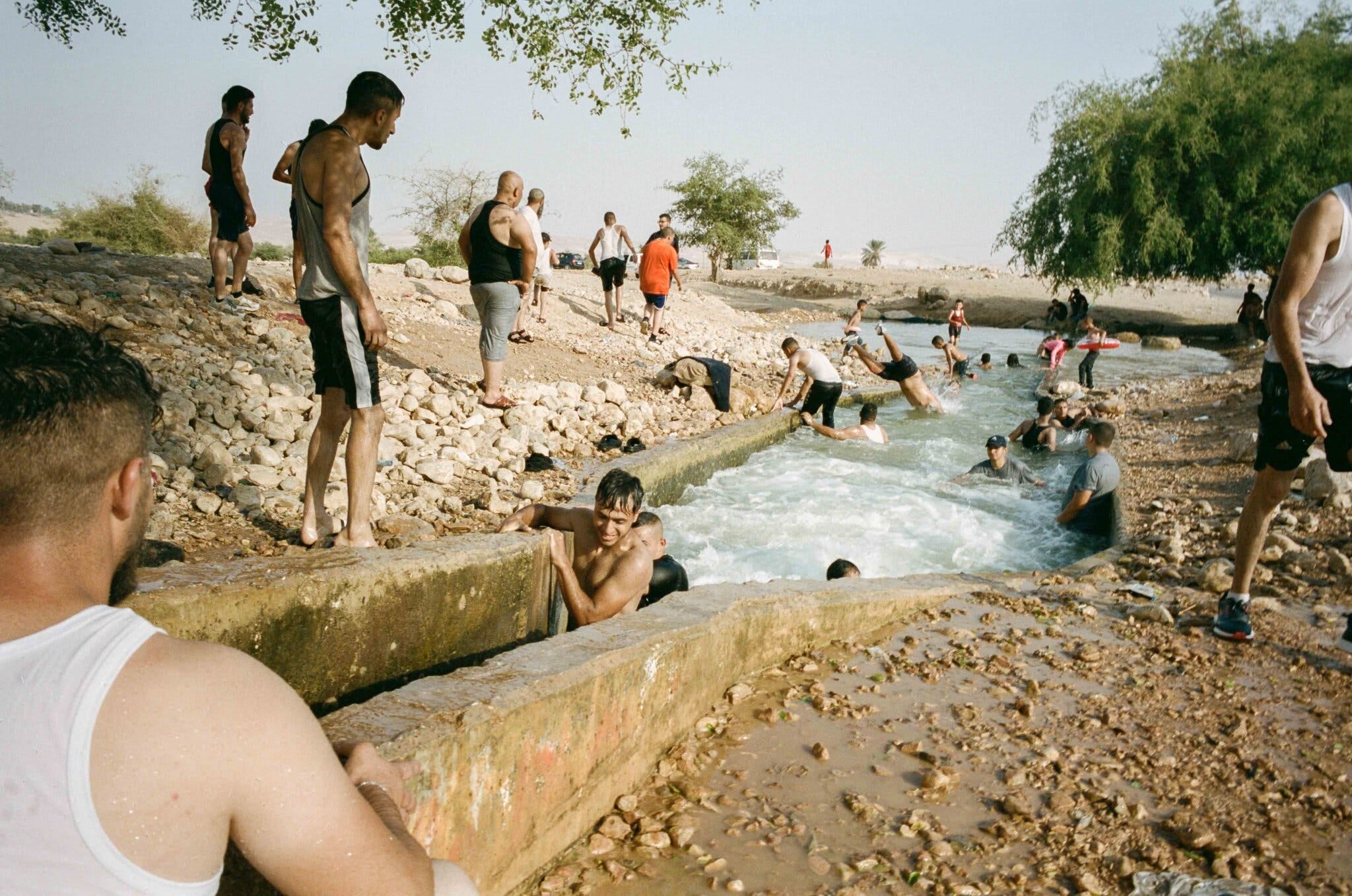
Adam Rouhana, a Palestinian-American photographer, describes his frustration at seeing images of Palestine in the western media which are at odds with the images he was making of everyday life in the community where he lived.
His New York Times article attempts to redress the balance a little.
In a week when Israeli forces killed three journalists in Gaza and Lebanon in one day, the opportunity to appreciate nuance seems like a luxury we cannot afford. But I have respect for Adam for persevering and getting his photo essay widely published.
“Journalists are being killed at a pace and scale that should shock the conscience of the world. These are not isolated tragedies; they reflect a systematic failure to uphold the most basic protections owed to civilian journalists under international law.”
– Sara Qudah, CPJ’s Middle East and North Africa Regional Director.
NAPALM GIRL Update: If you’ve been following the controversy surrounding the Netflix ‘documentary’, The Stringer, you might have seen that Nick Ut – the photographer who’s always been credited as the author of the Napalm Girl photo – has filed a defamation suit against Netflix in France.
PetaPixel have also published an interview with Michael Ebert, who manages the photographic estate of Horst Faas, the Picture Editor accused of changing the credit on the original photo.
“Those who have passed away never doubted Nick Ut’s authorship, and those who are still alive view the allegation with scepticism, at the very least.”
– Michael Ebert
Amongst his colleagues, Nick Ut’s “body of work and reputation are so enduring that this film has not harmed him”, says Ebert. Meanwhile, the World Press Photo has not yet restored Nick Ut’s credit for the photo and the Netflix film has been nominated for several Emmys. Go figure.
It’s highly unlikely that the truth will ever be fully known. It doesn’t seem as if there’s any more evidence to uncover. Perhaps the outcome of Nick’s defamation suit will provide some sense of closure, one way or another.
ICELAND: When I first saw this, I was sure it was an April Fool’s prank. I’m still not convinced it isn’t. However, in the hope that one enthusiastic reader will apply and find out for sure, here’s an attractive – if double-edged – opportunity.
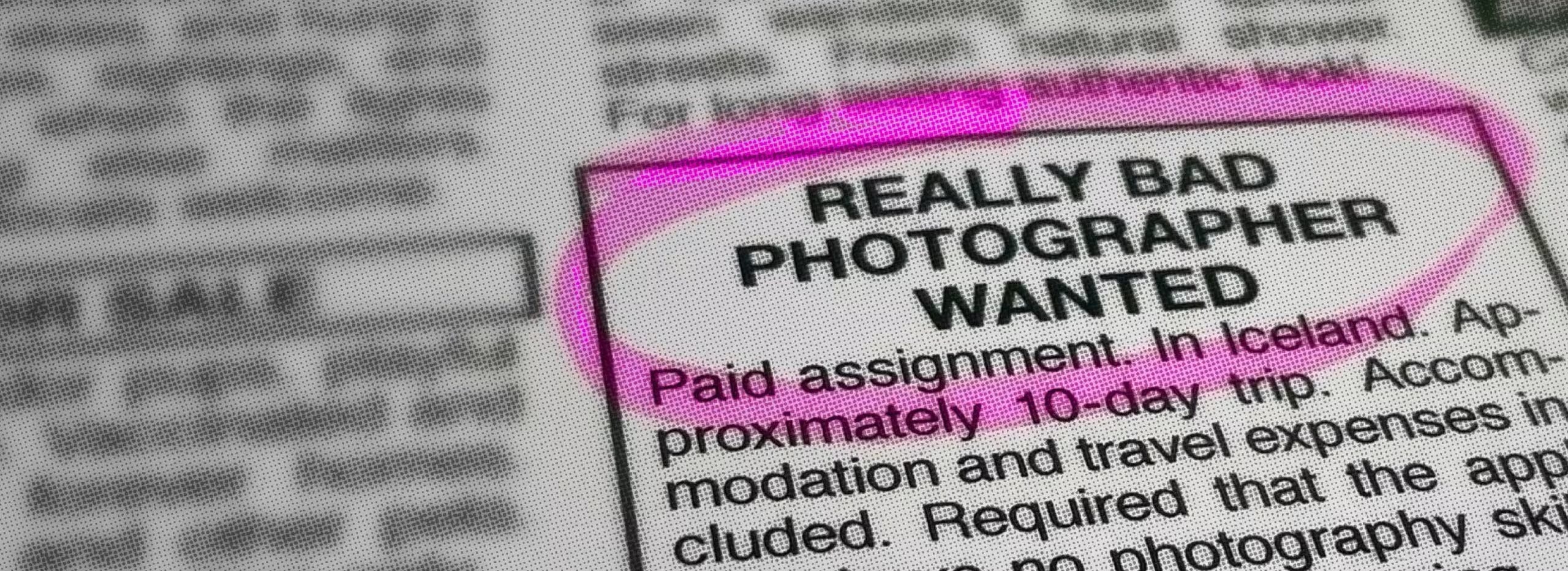
In an attempt to prove that even a poor photographer can’t help but make appealing images of Iceland, this contest promises impressive prizes for the worst photographer:
A ten-day trip to Iceland
All expenses paid
$50,000 for “photos content and participation”
Applications for ‘really bad photographers’ close on 30 April 2026.
And finally…
There’s a lot of dreariness around at the moment – and not only because I’m in England this week, where the weather is, unsurprisingly, cold, grey and damp. The news headlines seem to get bleaker every day and whilst we acknowledge the journalists who risk everything to keep us informed, some respite would be welcome.
Don’t worry. I’ve got you.
The Assembly is a series of TV interviews where celebrities are asked questions by a group of autistic and neurodivergent interviewers. The unfiltered questions range from “Are you happy to be alive?” to “Who is your dentist?”, all asked with the same authentic and disarming curiosity.
The new UK series earned a rare five-star review in The Guardian. In the first episode, Stephen Fry is asked, “How much have you spent on cocaine?” and “Can you help me meet Celine Dion?” The sincerity of the neurodivergent interviewers is met with refreshingly honest answers. It’s a simple but highly effective formula.
You can find many clips on YouTube. Here are two from the end of interviews where members of The Assembly house band perform a song that’s significant to their guest.
Sunshine on Leith performed for actor David Tennant
Movin’ on Up performed for actor Danny Dyer
I’m travelling for the rest of April and Beyond the Frame will take a break for the rest of this month. Paid subscriptions are automatically paused until May.
I wish you happy days and the very best light in the meantime.
Go well.

✤ Creative Inspiration
Lateral-thinking prompts, inspired by Brian Eno’s Oblique Strategies, designed with photographers in mind.
Read more and learn how to use my Oblique Strategies for Photographers.

Wow, another great newsletter. You were so lucky to see the halo. I like your evocative writing especially, ‘The ground-level busyness of tents and camels is reordered into punctuation marks upon a page of ochre sand.’ Brilliant. Wish I was there.
And thanks for the world press photos. I plan on seeing the exhibition. I wouldn’t have known about it without you.
And extra special thanks for the competition book ‘The photographic essay’. I am very happy.
Enjoy your travel!
I applied for Iceland’s worst photographer trip. I answered truthfully, so I probably won’t get chosen. :-)