
Beyond the Frame 88/ – The Psychology of Flow
Does being completely absorbed make for better photographs? From the silence of the darkroom to the chaos of Holi celebrations in India, I look at what happens when time dissolves.

When chaos brings clarity
Enter the Darkroom
For anyone who’s ever made prints at home, this is likely to be a familiar experience.
You go into the darkroom, close the door behind you and turn on the red “safe light”.
It’s 9 am.
You start to print negatives. You experiment with different paper grades, vary exposure times, sluice prints in a developing tray, then the stop bath, fixer, and finally the wash. Then you repeat, making adjustments, fine-tuning the process.
Forty-five minutes pass before you’re done.
You switch the red light off and step outside.
Inexplicably, it’s 6 pm.
Flow
This dramatic shift in our perception of time is a characteristic of a state of mind that psychologist Mihaly Csikszentmihalyi calls flow.
Flow happens when we are totally immersed in an activity. Our perception of time changes, self-consciousness evaporates, we’re in a place of complete mental absorption.
Flow happens when we are living in the moment, when we are in the zone.
“Apparently the way a long-distance swimmer felt when crossing the English Channel was almost identical to the way a chess player felt during a tournament or a climber progressing up a difficult rock face.”
– Mihaly Csikszentmihalyi
If you’ve watched any of the Winter Olympics, currently taking place in Italy, you will have seen many examples of athletes competing in a state of flow – and at least one who wishes they were.
I’ve just seen highlights from the disturbingly named Skeleton event. Team GB gold medal winner Matt Weston describes it as “launching yourself headfirst down a frozen water slide at up to 130 kilometres per hour on a very expensive tea tray”.
Absolute focus, split-second decision-making, peak physical effort, all honed during years of rigorous training, culminating in 56 eye-watering seconds of sporting excellence. That’s being in a state of flow.
But flow is not an experience reserved only for elite athletes. Flow can be experienced by a child immersed in building a Lego castle, by anybody fully focused on learning a musical instrument, by a gardener carefully pruning roses, or by a photographer making prints in a darkroom.
“Olympians do not have an exclusive gift in finding enjoyment in pushing performance beyond existing boundaries. Every person, no matter how unfit he or she is, can rise a little higher, go a little faster, and grow to be a little stronger. The joy of surpassing the limits of the body is open to all.”
– Mihaly Csikszentmihalyi
Photography and Flow
From his extensive research, Mihaly learned that a state of flow is most likely to occur when certain conditions are met:
The task must be challenging but not overwhelming. It should stretch our capacity enough to require commitment and concentration.
Goals should be clearly defined. We need to know specifically what we’re aiming for.
Feedback should, ideally, be immediate so we can gauge whether our efforts are succeeding.
The activity should be voluntary. Perhaps this is why flow is more often reported by people engaging in sports and hobbies than it is by those sitting at office desks?
If there have been times when I’ve experienced a state of flow, they’ve mostly arrived when I’ve had a camera in my hand.
It’s not guaranteed. Indeed, flow is elusive.
Sometimes it arrives quietly, perhaps in the darkroom or when patiently waiting for what Henri Cartier-Bresson described as “a simultaneous coalition” of elements – the right light, a certain moment, a glance, a movement, an interaction.
At other times it arrives amidst noise and disorder, when the rush of energy demands that our full attention be given to a dozen different things at once.
It’s hard to predict and most likely only recognised in retrospect, when we reflect and declare, “Wow! That was fun.”
Holi
When it comes to chaotic energy, there are few events more vibrant than India’s Festival of Colour – Holi.
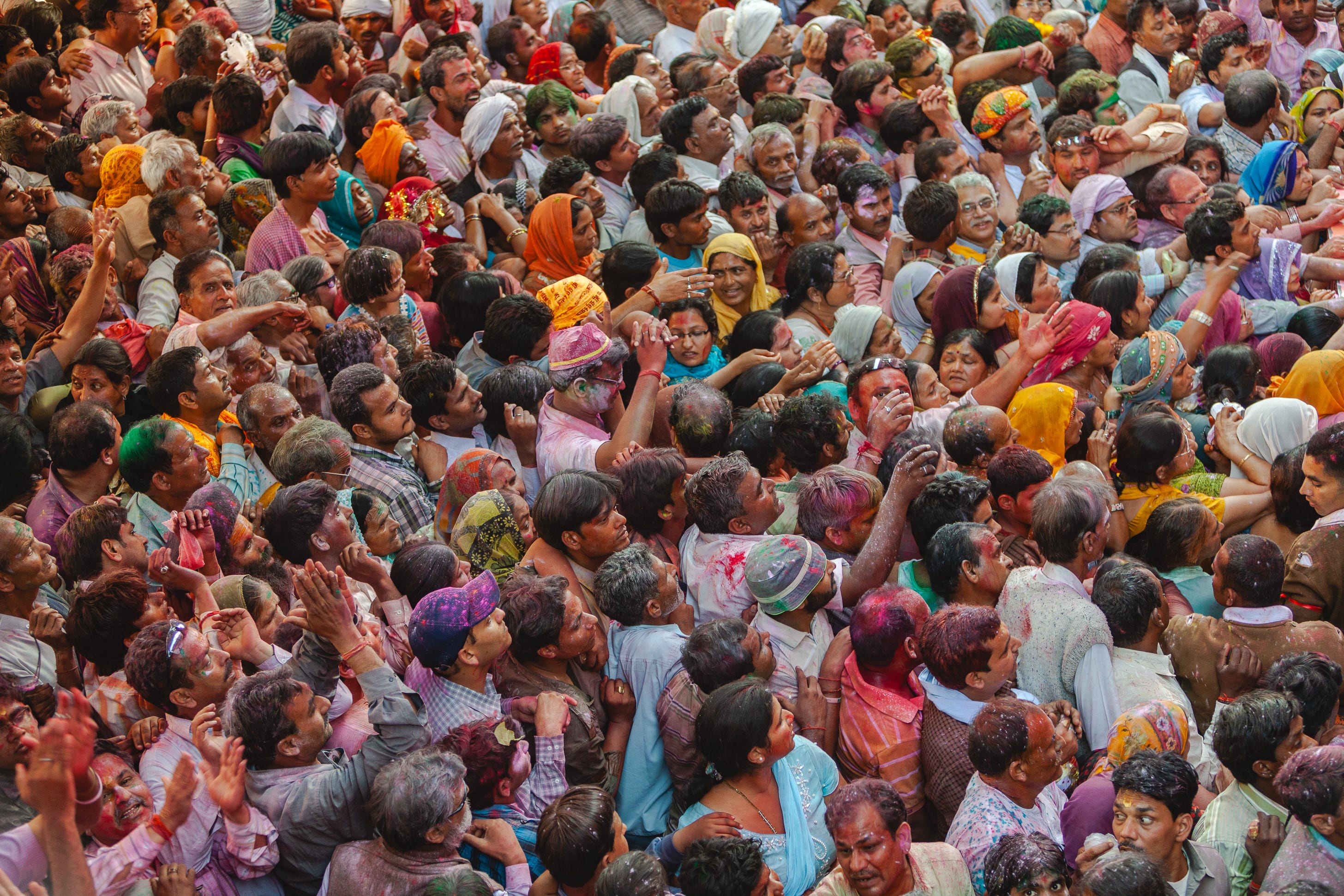
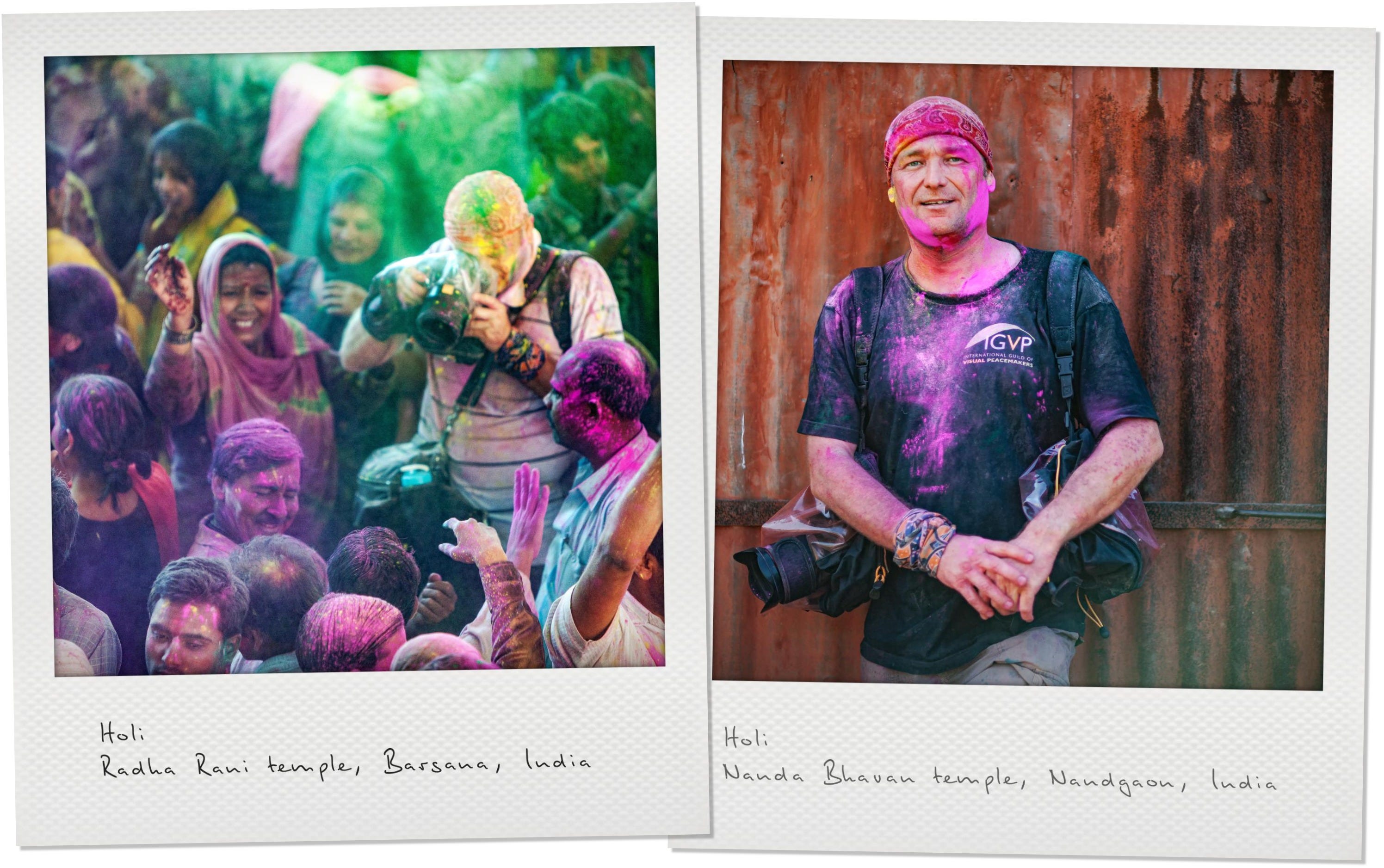
The Radha Rani Temple in Uttar Pradesh is packed. Thousands of devotees are jammed inside, shoulder-to-shoulder. The music is loud, the singing is louder still, the dancing is frenzied, the air is thick with coloured powder, green, yellow, purple.
This is not a place for quiet reflection. It’s a full-on, non-stop sensory overload.
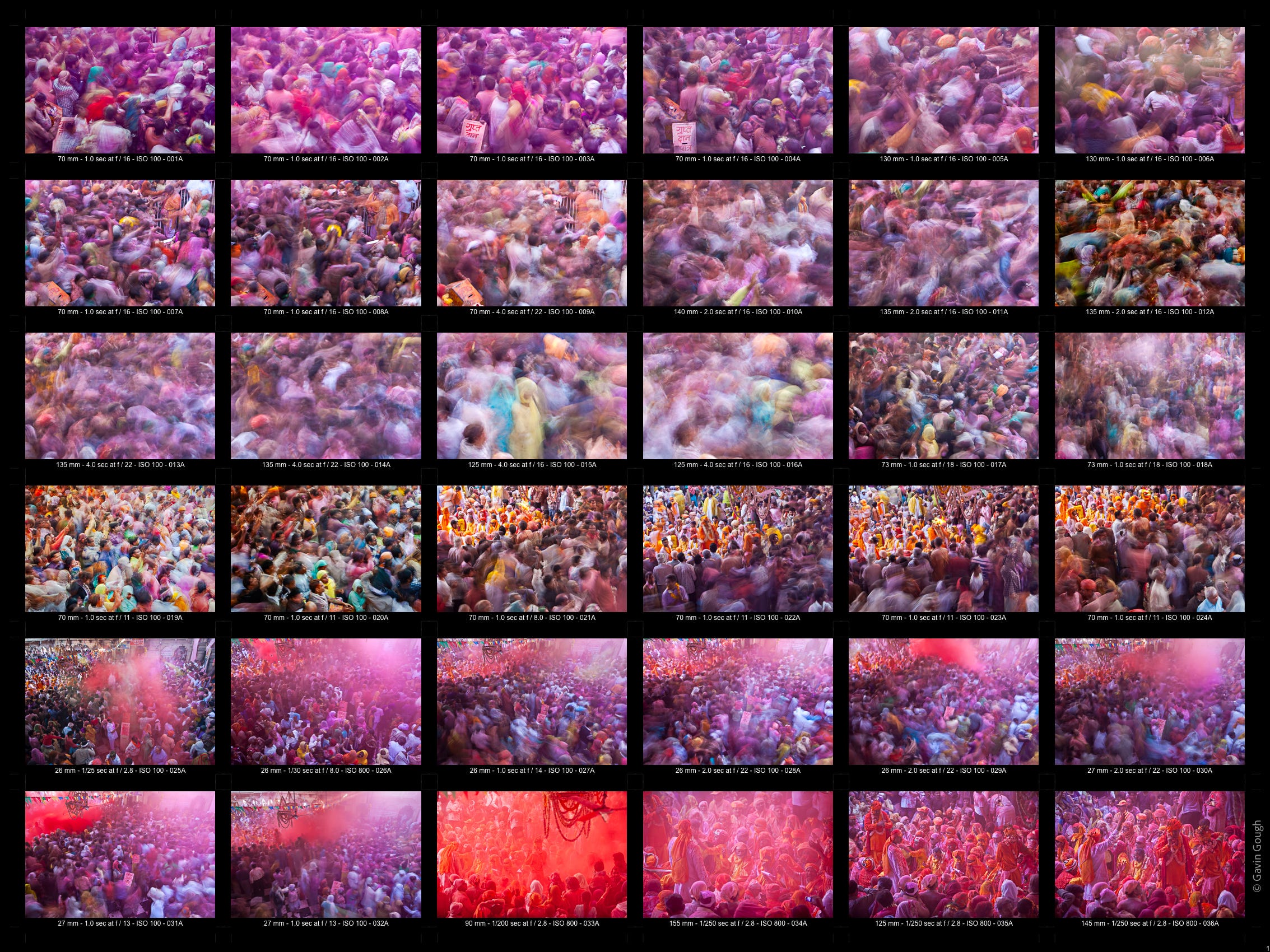
I’m experimenting with shutter speeds. Too fast and movement is frozen, the sense of constant motion lost.
1/30th of a second?
1/15th?
At one and two full seconds, individuals merge into a blurred mass of humanity – which is how it appeared – no longer individuals but one multi-coloured, rhythmic, writhing entity.
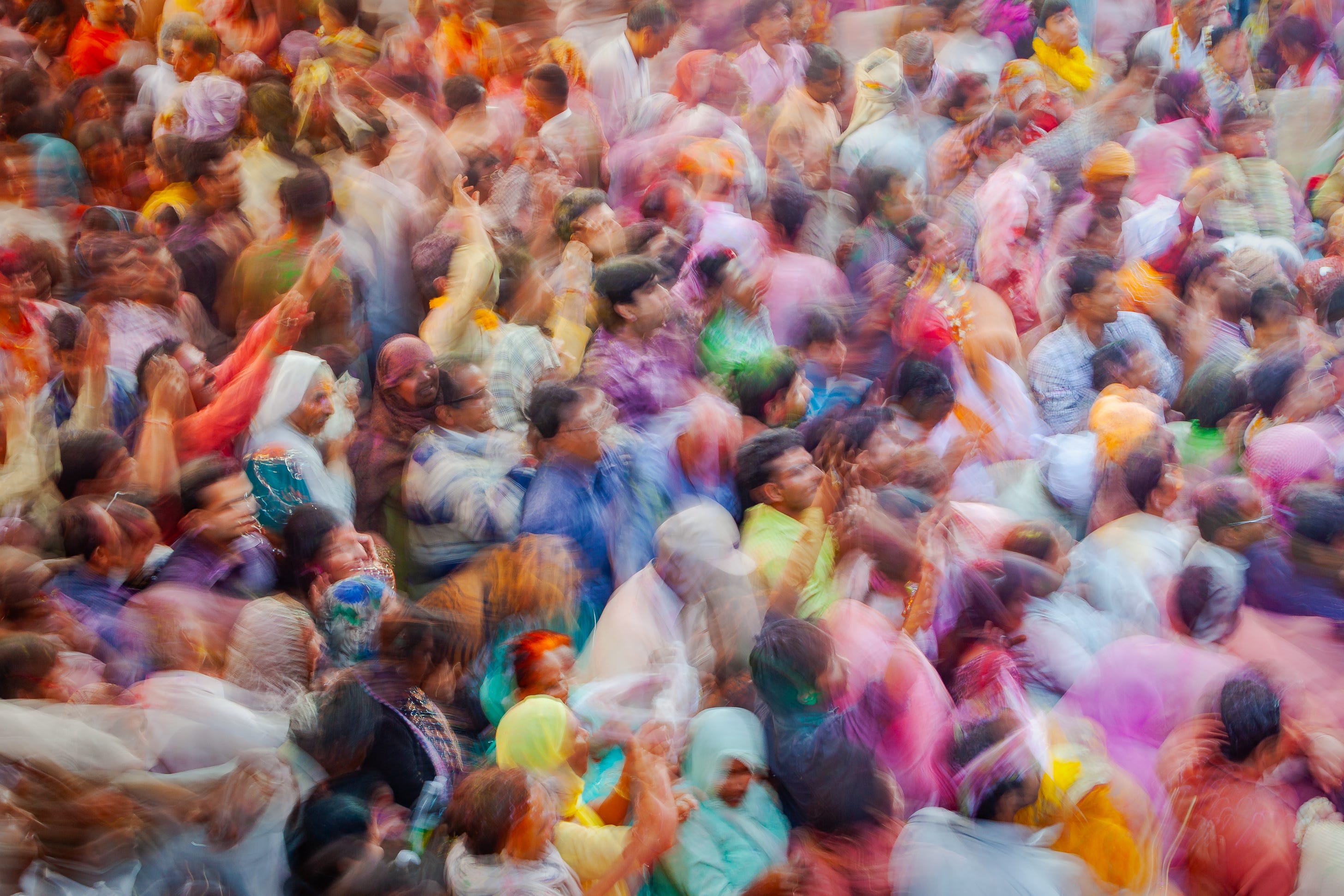
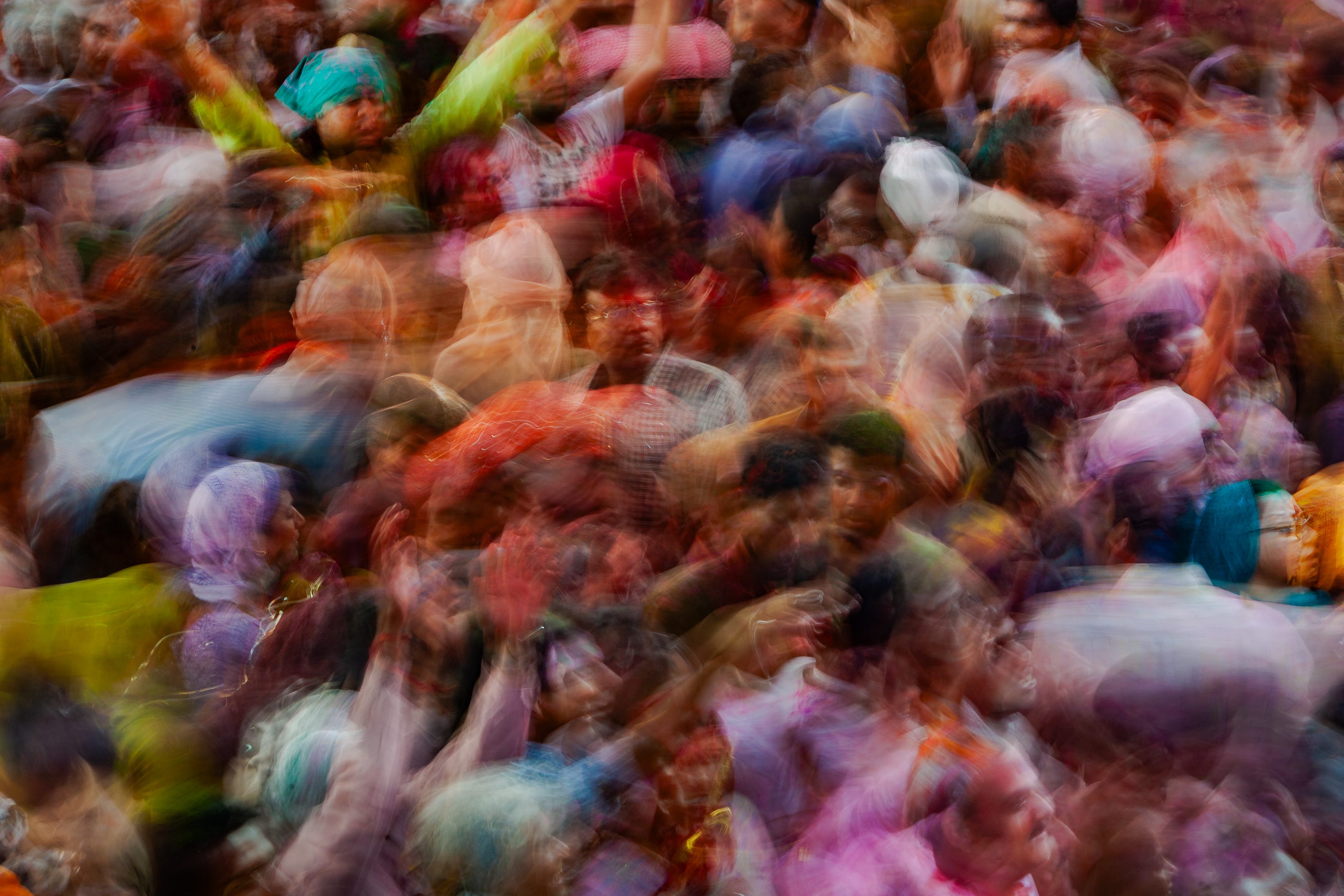
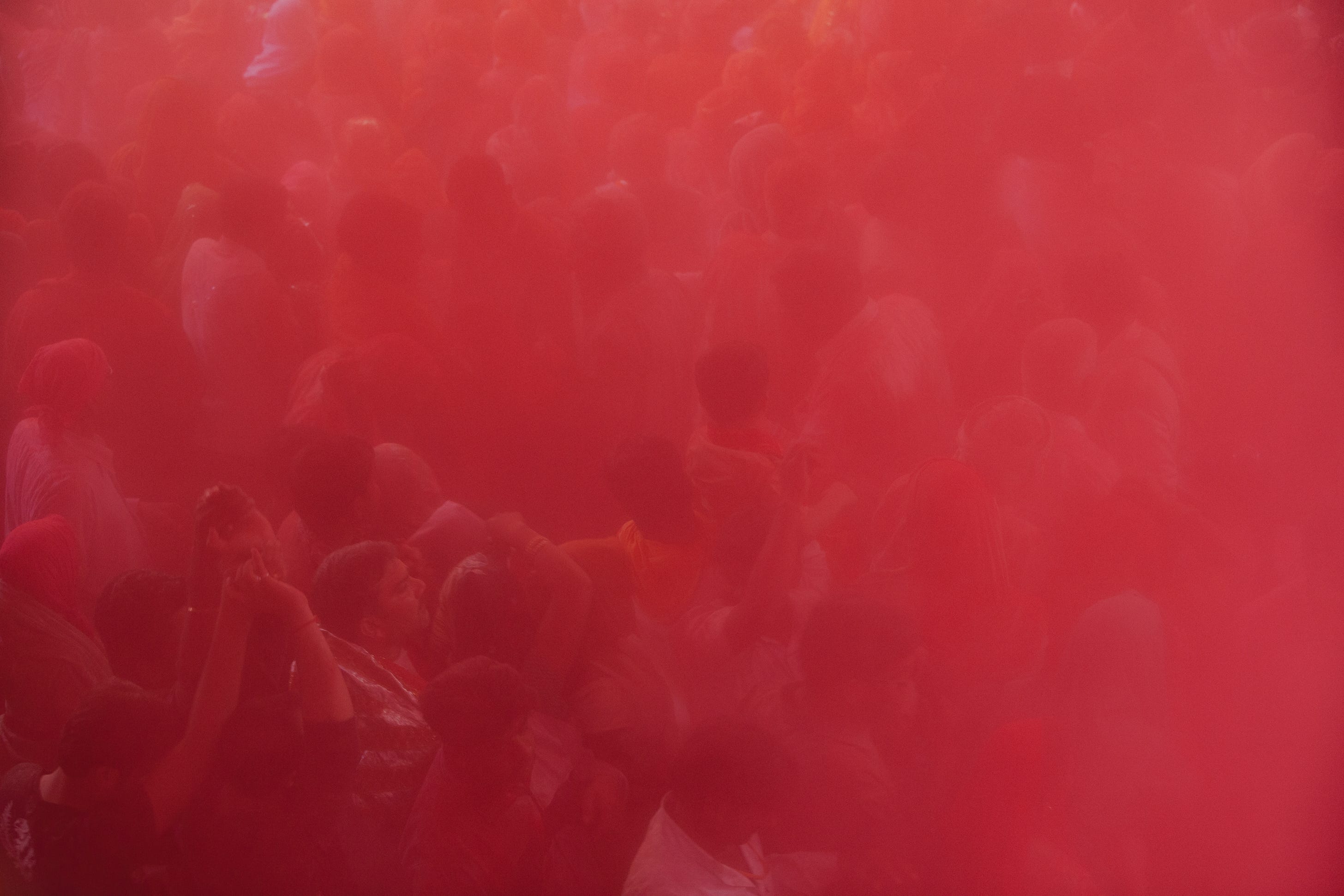
I venture downstairs to the temple floor and become a part of the swirling crowd, swept this way and that without warning.
There’s too much coloured powder in the air for my camera to auto-focus and barely enough space to raise my arms, let alone check the camera settings. There’s no time, no space, no pause, only this moment.
This is the point at which instinct and muscle memory kick in.
A longer lens allows me to frame tightly. I’m hoping my manual focusing is picking out hands raised above the crowd.
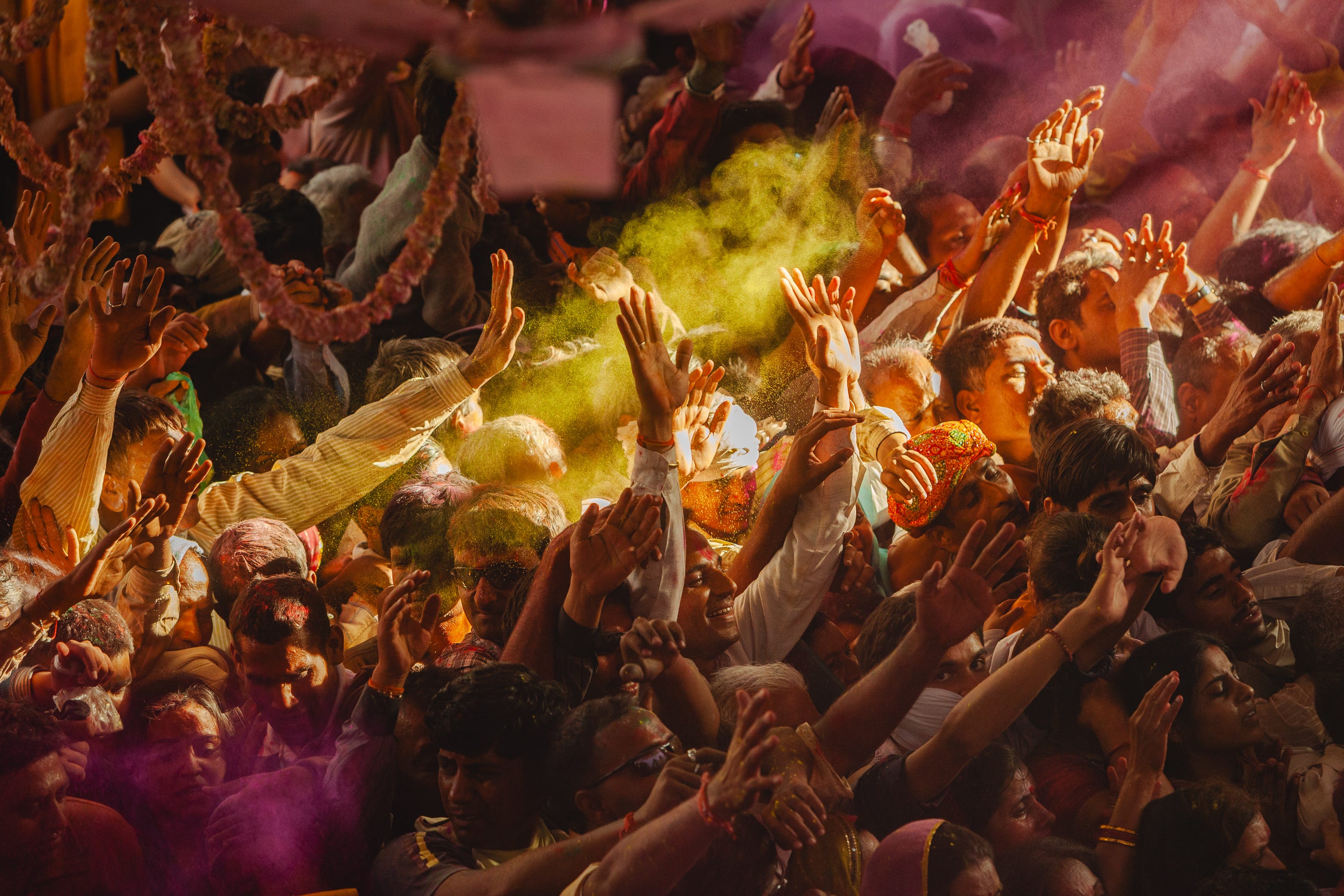
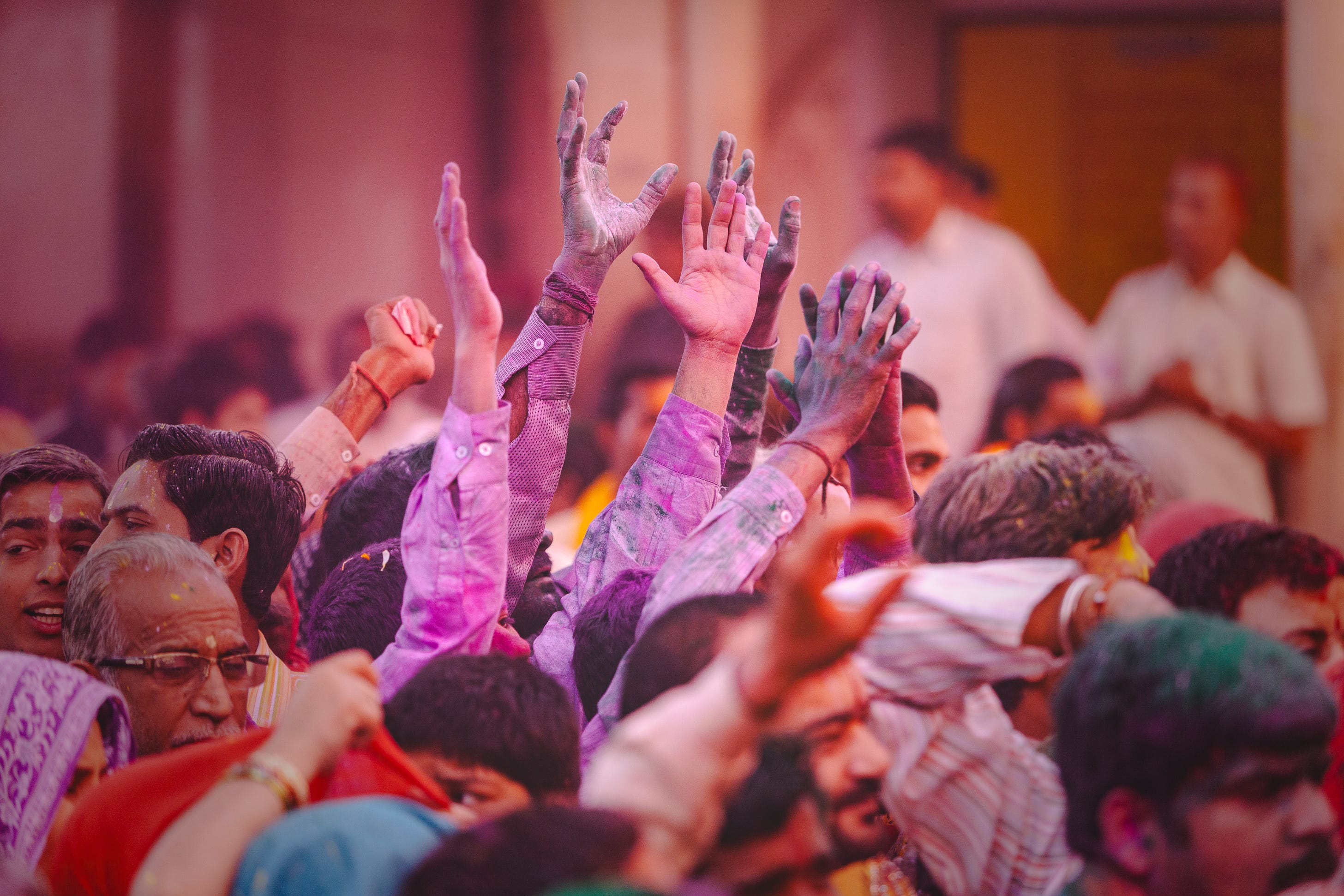
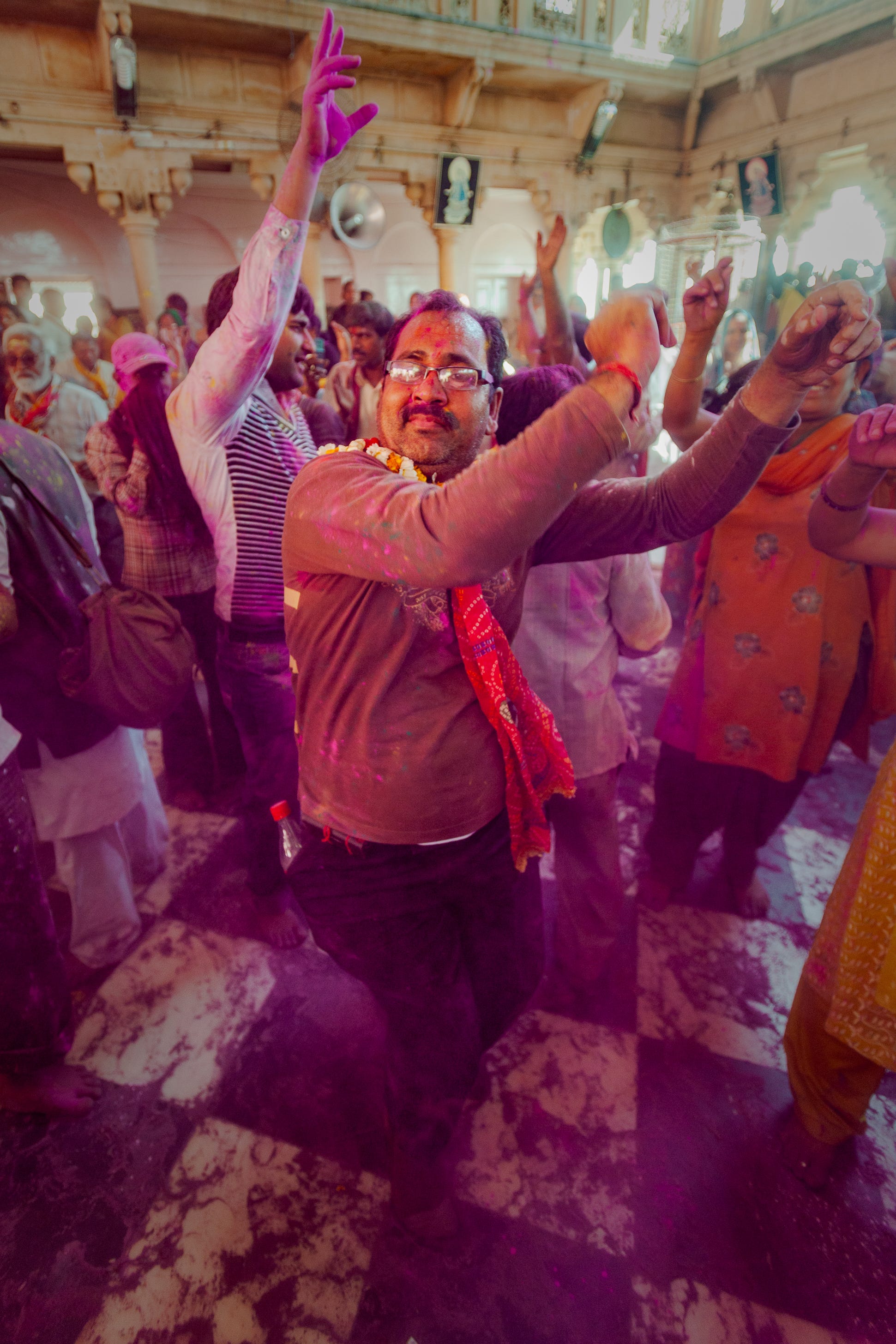
A wider angle is more forgiving and gives me some hope of framing flamboyant dance moves, even though I’m within easy reach of swinging arms.
There’s a jostling intimacy; no hierarchy, everyone is a part of the same exuberant celebration. Despite the noise and the movement and the air thick with powder, it’s wonderfully good-natured and uplifting. I’m swept up in the euphoria.
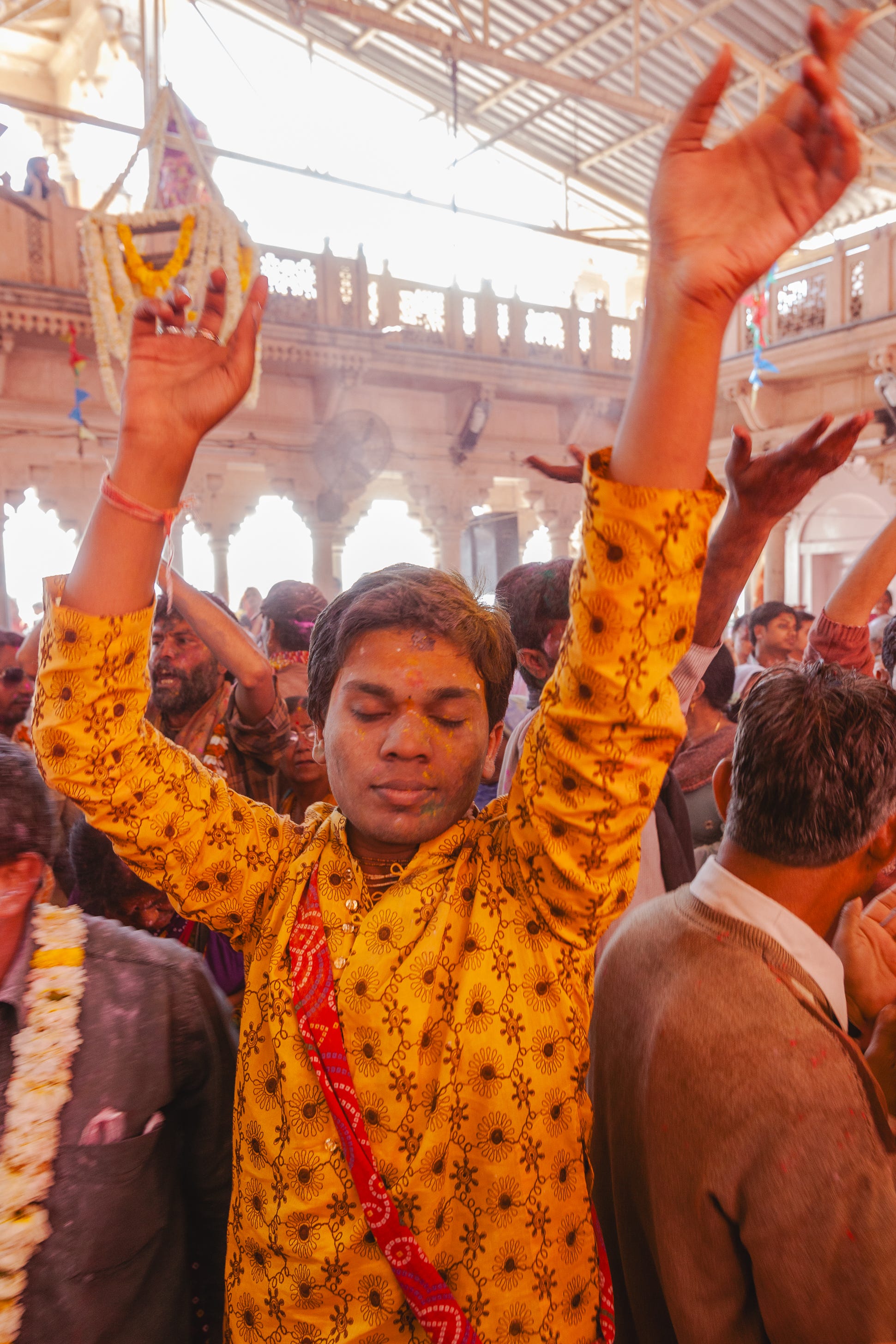
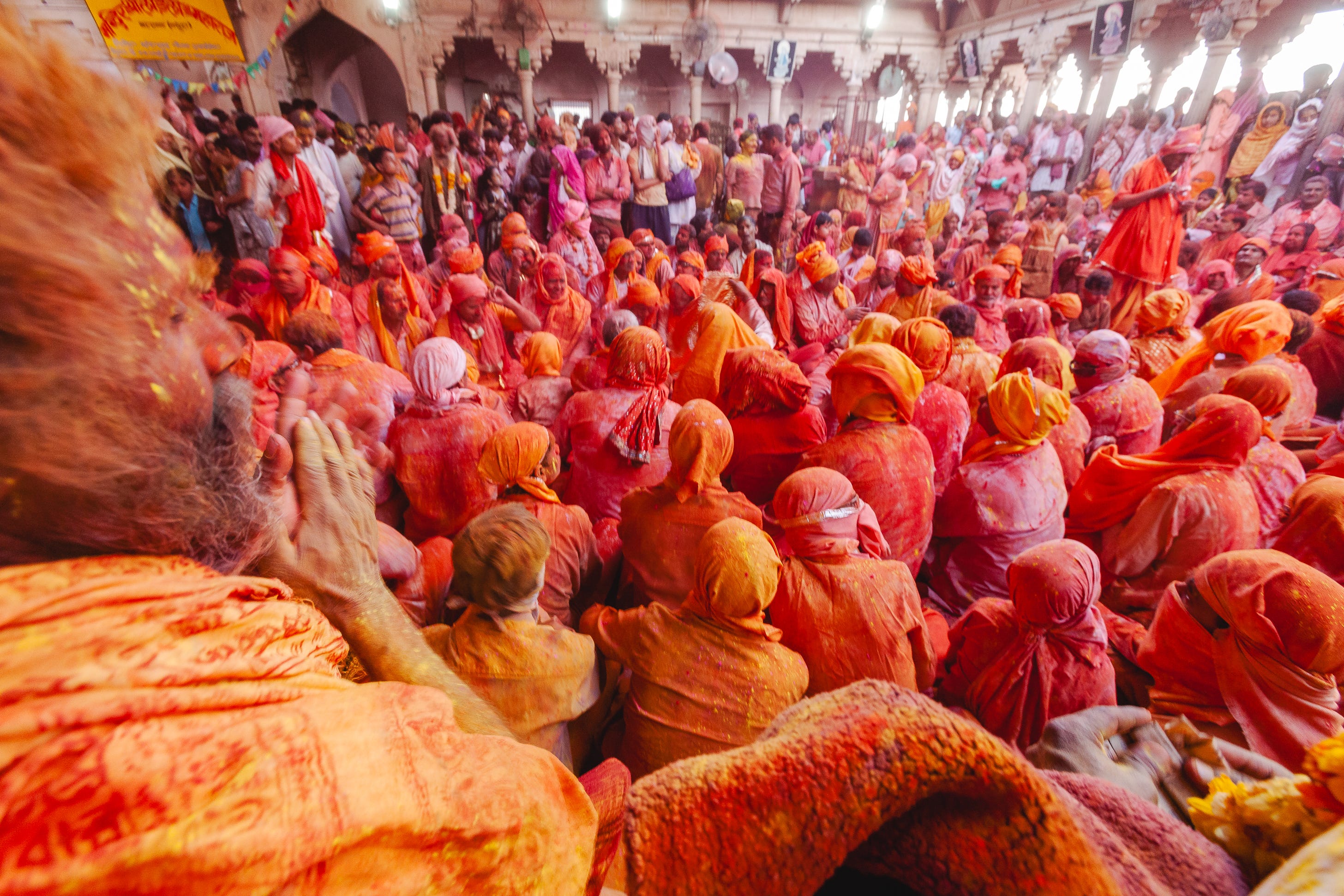
At times the frenzy calms a little. Large groups of musicians, doused in yellow and orange, enter the hall and sit to play.
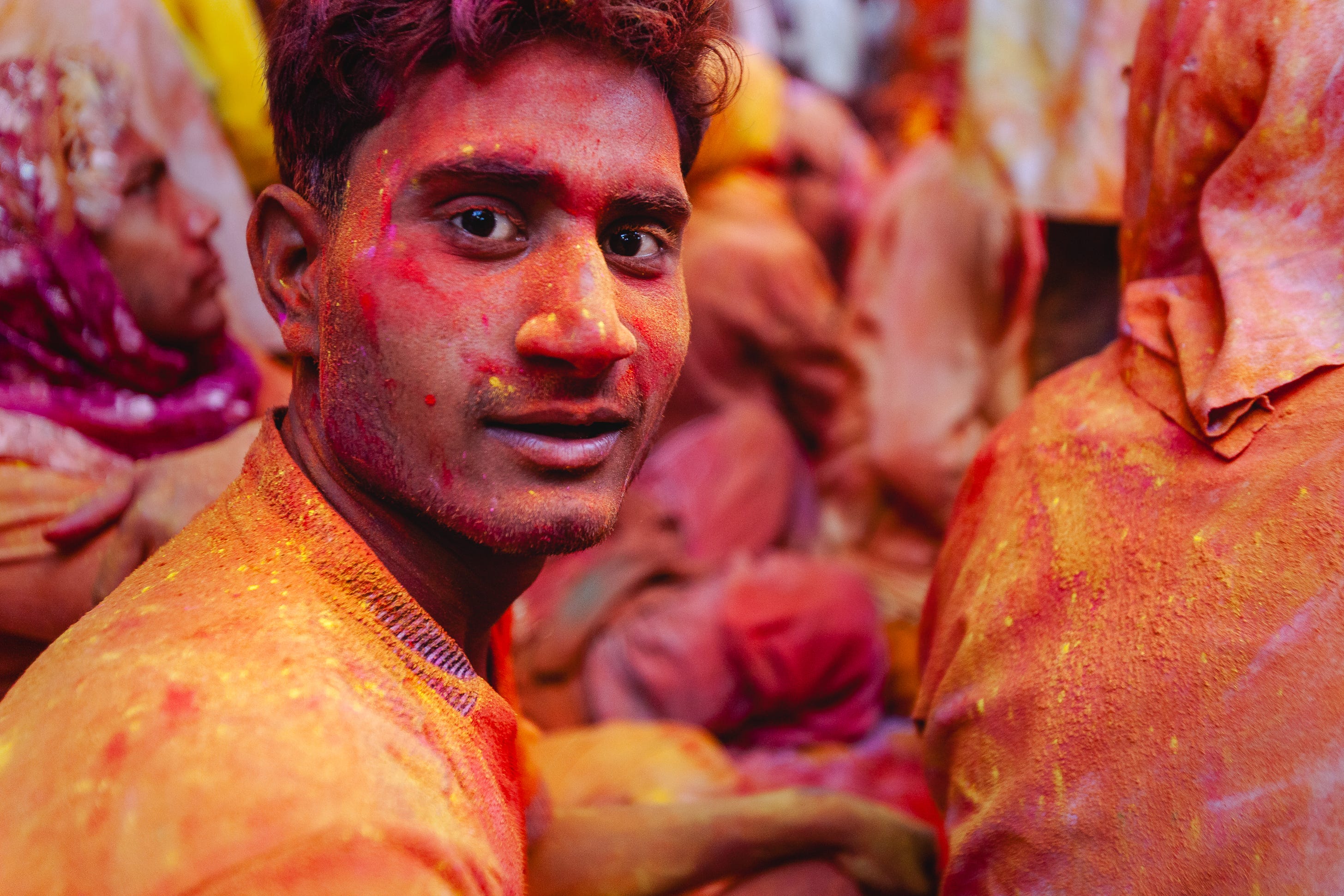
I take the opportunity to sit with them, finding faces to bring some sense of the individuals who are a part of the crowd.
The frenzied flow
In retrospect, there’s no alternative to being in the moment in a situation like this.
There’s no time to think and little space to move. But I don’t think “hitting and hoping” would be a successful strategy. It’s necessary to be aware of several things at once: the ebb and flow of the crowd, one’s position within it, camera settings, framing (as far as possible).
There’s also the safety aspect. Large crowds can be unpredictable. Am I in the way? Am I interfering too much in the proceedings? Is my presence appropriate?
Fortunately, in this joyful celebration, everybody is welcome if they bring a smile and some intriguing dance moves. All my dance moves are intriguing and I couldn’t help but smile so I was fine.
Feel the flow
Holi lasts several days and I’ve documented many of the peripheral activities. I spent about two hours in the main hall of the Radha Rani temple when celebrations are at their most intense. It felt more like six. When so much is happening so rapidly, time expands.
Mihaly describes one of the components of flow as “a deep but effortless involvement that removes from awareness the worries and frustrations of everyday life.”
It’s fair to say that during Holi, the worries and frustrations of everyday life were the last thing on my mind.
Does flow make better photographs?
Most photographs are made outside a state of flow, in my experience.
It’s rare to be so fully engaged that we are completely in the moment. The necessary conditions do not readily coalesce and they can be hard to manufacture.
I don’t think work made from a flow state is necessarily better. Perhaps the value of flow in photography isn’t in the finished photograph but in the act of making it. It’s found when we abandon our need to measure the passing of time, in those moments when we forget ourselves and direct our attention outward.
Our modern, social-media world has been engineered to fracture our attention into fleeting seconds. Opportunities to be fully immersed in a task are increasingly rare. That may be reason enough to seek them out.
Want more flow in your life?
In his book, Flow, Mihaly describes ways in which we can increase our capacity for flow.
If you’re interested in learning more, I can recommend the book. It’s thoughtful and insightful, explains findings from his research in layman’s terms.
If you’d like a guaranteed place to find a flow state but the thought of training for an Olympic Skeleton run doesn’t appeal, then I’ll meet you at the Radha Rani temple.
“To photograph is to hold one’s breath, when all faculties converge to capture fleeting reality. It’s at that precise moment that mastering an image becomes a great physical and intellectual joy.”
– Henri Cartier-Bresson
Beyond the Frame Recommendations
Articles, documentaries, exhibitions, podcasts and more.
❖ Pitch – Visa pour l’Image

Professional photographers are invited to submit reportage projects to be screened or exhibited at the 2026 edition of Visa pour l’Image in Perpignan, France.
▶︎ Watch – Mihaly Csikszentmihalyi’s TED talk
☆ Read – Flow by Mihaly Csikszentmihalyi

The psychologist reveals what he’s learned about the “psychology of optimal experience.”
✤ Create
A series of creative prompts, inspired by Brian Eno’s Oblique Strategies, and designed with photographers in mind.

Read more about the concept and learn how to use my Oblique Strategies for Photographers.
And finally…
I’m moving this week. Leaving bustling Bangkok for gentle Geneva. Swapping sunshine for snow.
Wherever you are and whatever the weather, I hope you find some moments of undistracted attention.
Until next time, flow well.

◼︎ Directory: Archive of Beyond the Frame newsletters.
◼︎ Resources: Recommended books, films, gear, media etc.
