

A tale of loss in four frames
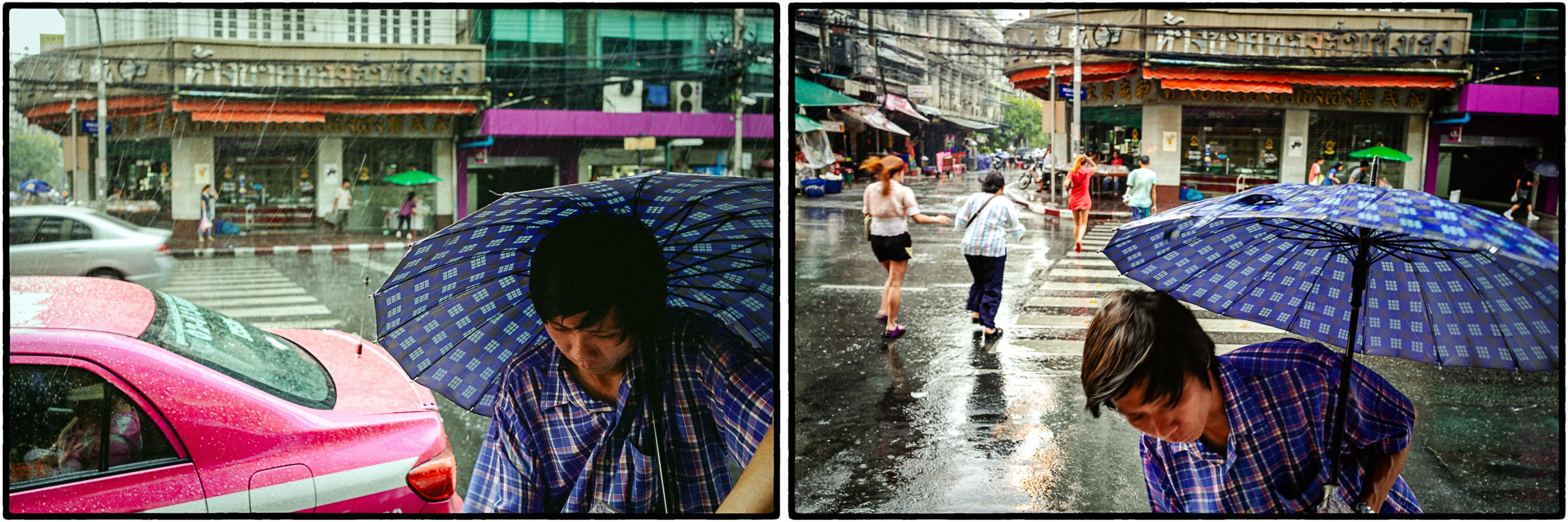
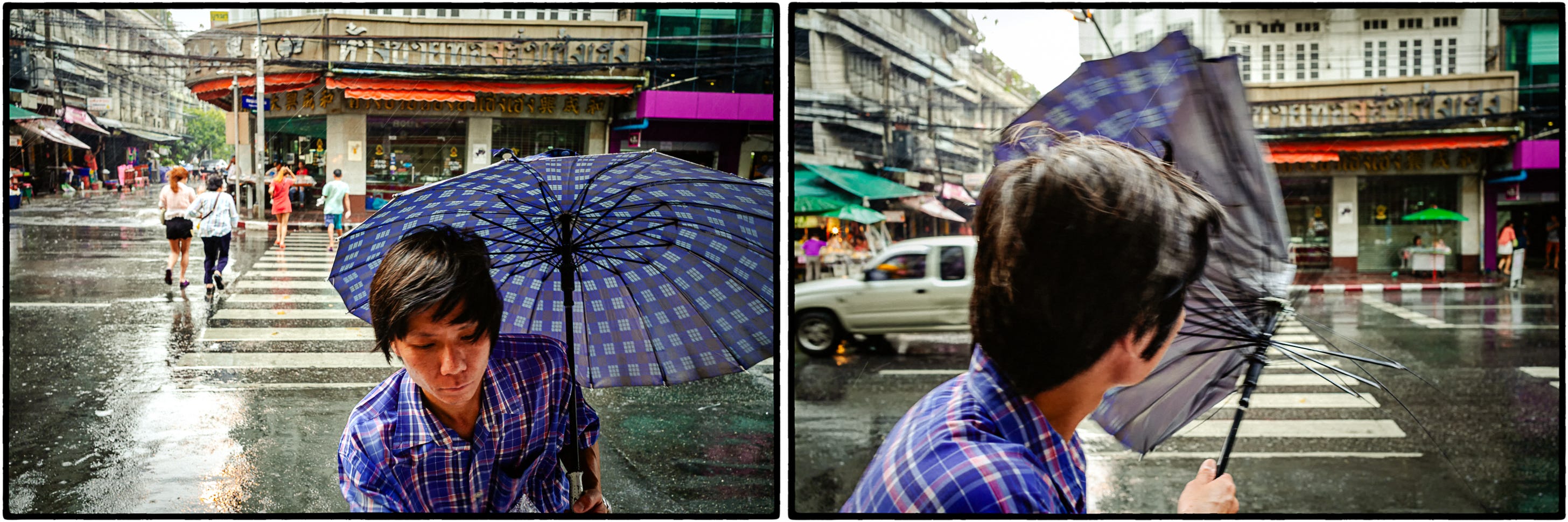
It’s rainy season in Bangkok. And when the rain falls here, it is not subtle. Gentle, cosy words like shower and drizzle are redundant here. It’s always a downpour, a deluge or a torrent.
When the rain comes – always suddenly and at full force – people move differently. Elegance and poise are immediately sacrificed in favour of a hurried, crosswalk-dashing, puddle-hopping sprint for cover.
Was this man’s closely-matched combination of blue checked umbrella and blue checked shirt a conscious choice or merely coincidence? The storm doesn’t care. Its only job is to upend his day.
Job done.
Don’t be a chimp
The LCD screen in the back of our cameras is a helpful tool. However, it also comes with an inherent risk, which is why my camera screen is always turned off.
It’s called “chimping”. A slightly derogatory term used to describe photographers scrolling through their images in the screen of a digital camera, saying “Ooh! Ooh! OOH!” like an excited chimpanzee.
JC Pieri’s video of a chimpanzee demonstrating “chimping” has been viewed over 122 million times. When a chimp does it, it’s impressive. Arguably less so for human photographers.
I don’t like to describe it as chimping, but it is definitely a habit that many digital photographers develop. I understand the temptation. The ability to quickly review images, to check composition and exposure… it’s a valuable tool. But like many temptations, it comes with an inherent downside.
Most digital cameras have the auto-review option turned on by default. When we make a frame, the image appears almost instantly in the LCD screen. A quick check is reassuring and provides the sort of instant gratification that can be hard to resist.
However, that habit quickly builds into a Pavlovian reaction. Click the shutter, look at the screen. Click the shutter, look at the screen. Click the shutter…
Bad habits
Four reasons why constantly looking at the camera’s screen is a bad habit:
It kills our attention. The rhythm of photographing demands our full attention. We’re observing, noticing, anticipating. If we’re photographing a landscape, we’re watching the light shift. A street scene, we’re anticipating a moment, an interaction. With portraits, we’re looking for expressions, a shift in pose, a fleeting smile. It’s the very nature of almost all photography and, arguably, a skill that defines the best photographers: the ability to be immersed in the moment, to be fully attentive, ready to anticipate what Henri Cartier-Bresson described as “rhythm in the world of real things.” Do you know what simple action will immediately dissolve the level of attention we’re seeking? Looking away. Being distracted. Attention is everything.
It’s impolite. In any kind of portrait photography, the connection between photographer and subject is paramount. The camera is an obstacle, a black box barrier that must be relegated to a place of almost zero importance. If you’re making portraits but constantly looking at your camera, you’re bringing the quality of your connection back to a flatline each time. You wouldn’t go on a first date to a candlelit restaurant and be constantly looking at your phone. Obviously, that would be rude and you’re unlikely to progress to a second date. Attention is everything.
You don’t know what you’re missing. In those seconds when we might be looking at our camera screen, we’re no longer clicking the shutter, moments are slipping away unnoticed. Who knows what might be happening in front of our eyes, if only our eyes weren’t glued to our camera screens? Attention is everything – and not only in photography, come to think of it. But that’s another story.
It kills your confidence. It’s possible that the need to immediately review every frame becomes a habitual crutch for photographers who aren’t confident in their ability. If you can’t be reasonably sure that you’ve picked the best metering mode, dialled-in the right aperture, flipped the shutter at the right moment, always checking the LCD screen won’t help you build that confidence. Confidence is built upon making mistakes and learning from them. So just keep making photos and learn to trust your judgement, not the LCD screen.
A better strategy
In the bang-for-your-buck ratio of effort to reward, this might be the best photography tip ever:
Turn off the auto-review setting on your camera.
That’s it!
You can still review images, but only after the moment has passed, when you’ve made your series of images, when the portrait session reaches a natural pause.
At that point the ability to quickly review images is one of the great benefits of digital photography. Go ahead, check the histograms, review compositions, check focus sharpness, etc. but by waiting, you will have maintained your full attention to the moment. Complete attention is the most valuable skill any photographer can possess.
Two example stories
I’ve noticed that photographers who started out using film cameras are less likely to develop this bad habit. Working without the luxury of a digital screen removed that potential distraction. Film photographers have no expectation of instant gratification. Knowing that it could be weeks or months before seeing an image provides film photographers with a great incentive to know their camera well, to understand how it reads light, to know how various apertures affect depth-of-field with different lenses.
A photographer looking at their camera screen after every frame is like a violinist playing back a recording after every note. It might offer some reassurance that they’re playing the right notes but they’ll never make beautiful music.
Girls Running Home by William Albert Allard

This photo, made by William Albert Allard in 1967, has long been one of my favourites. I’m fortunate to have a signed copy hanging on my study wall.
In interviews, Allard often shares a clear recollection of the moment.
“I was in the French Basque country, standing on the edge of a road leading to a small village in the Pyrenees… it was at that wonderful time of the day when the sun has gone down but it’s not yet dark… in France, they have this wonderful phrase, ‘Entre chien et loup’ that means, the time between dogs and wolves.”
“I heard the pitter-patter of children’s feet on the gravel, passing behind me. I turned and I saw these two little girls… I raised my Leica and I quickly framed two vertical pictures.”
“I didn’t get back to the office until a month or so later. I went through the film and I saw these two frames. The first was blurry – and the second was just kind of magical. These two girls weren’t really running or skipping; they were floating. Each had little red socks on – you see that tiny, little accent of red, which can be such a significant colour in a composition.”
Imagine fast forwarding to the digital age, how differently that last quote might read if Allard had developed a chimping habit.
“The first frame was blurry – I didn’t make a second because I was looking at my camera. When I looked up, the girls had gone.”
You get my point. Attention is everything.
For the record, I know for sure that Allard hasn’t developed a chimping habit in the digital age. He’s reliably old school, in the very best sense of the phrase.
The President and the Intern
In 1996, during the presidential campaign in the USA, photographer Dirck Halstead was working at a fundraising event for the Democratic party.
Unlike most of his colleagues who’d already switched to digital, Halstead was working with an analogue camera loaded with film. As usual, he made hundreds of frames during the event, many very similar to each other, most were unremarkable photos featuring Clinton greeting supporters; nothing very newsworthy.
Halstead’s fellow photographers also made hundreds of frames, but because they were working with digital cameras, they reviewed and deleted the files that weren’t “worth keeping” at the end of the night.
Within a year, the Monica Lewinsky scandal erupted and picture editors around the world were desperate to find a photo of the young intern.
No prizes for guessing where this story is heading.

No other photographers had kept their photos of Bill Clinton hugging Monica Lewinsky. At the time, she had been an unknown intern, in no way newsworthy.
Within a year she was at the centre of one of the biggest political scandals of the 1990s and Halstead’s “unremarkable” analogue photo would appear in newspapers and on magazine covers around the world.
Chimping, it turns out, can lead to premature ejection. And if that doesn’t persuade you to break the habit…
TL;DR
If you want to improve your chances of making a timeless photo like Bill Allard’s or if you hope to see your work on the cover of Time magazine, don’t be a chimp.
And don’t delete your original raw files. Ever.
Attention is everything. Thank you for yours.
A good picture is born from a state of grace. Grace becomes manifest when one is free from conventions, free as a child in their first discovery of reality.
The game is then to organise the triangle.
– Sergio Larraín
Beyond the Frame Recommendations
Articles, documentaries, exhibitions, podcasts and more.
☆ Read
A World in Colour: Nordic edition

If you’ve been following my updates about Magnum’s digitising of their huge archive of slides, you’ll want to see the final chapter of the World of Colour project: The Nordic Edition.
As with all the previous editions, the Nordic edition contains images that have never been seen publicly before. The scanned slides have all the evocative characteristics that we associate with colour images from the 20th century. Blocky shadows, teal skies, amber colour shifts and the immediacy of unedited pictures, just as the photographer saw them.
Dare I say, for all their apparent lack of sophistication, the original images – untroubled by digital manipulation and dizzying dynamic ranges – seem all the more tangible, more real. Perhaps I have a kind of synaesthesia; when I look at these lovingly restored photos, I feel my taste buds tingle.
We can also see examples of the full transparency mounts, with all the handwritten annotations, which enhance the sense that we’re seeing something authentic and unadulterated. Increasingly these days, that’s a welcome experience.

I’ve written about previous editions of the World in Colour project in Beyond the Frame editions 69/ and 71/, and reviewed my visit to the exhibition in London in Beyond the Frame 72/.
◉ Listen
Interview with Dirck Halstead

If you’re interested in learning more about Dirck Halstead (see the Bill Clinton story above), there’s a recording of an interview he gave in 2010 at New York’s Binghamton University.
He doesn’t speak about his famous Lewinsky photo but he does reveal some unexpected observations about the former president.
▶︎ Watch
William Albert Allard on Capturing Moments
This is my 80th newsletter. Much of what I’ve written attempts to convey what Allard manages to get across in two and a half minutes in this National Geographic video.
Emotion. Engagement. Passion. Serendipity. Attention. Grace.
There you go. Six words that define the essential ingredients of any meaningful artistic endeavour. Thank you, Bill.
❖ See
Sergio Larraín exhibition in New York

You can see a collection of the works of Chilean photographer Sergio Larraín in New York until 12 January 2026.
Prints from the Magnum archive are on display at the International Center of Photography in Manhattan.
I’ve written about the life and work of Sergio Larraín in Beyond the Frame 39/.
I’m disappointed that I didn’t get a chance to see the exhibition when I was in New York last month. If you’re able to visit, I hope you’ll enjoy seeing the prints up close.
Press release for the Sergio Larraín: Wanderings exhibition.
✤ Create
A series of creative prompts, inspired by Brian Eno’s Oblique Strategies, and designed with photographers in mind.
Read more about the concept and learn how to use my Oblique Strategies for Photographers.
And finally…
It’s only four days until the winter solstice in the northern hemisphere. Four days until the shortest day and then the light will gradually return.
I don’t mind the winter, provided there are occasional bright days – I can’t be doing with those dreary, overcast days when all the colour has been sucked out of the world – but I’m always happier after the solstice, when Spring’s arrival is approaching.
Whether you’re in the northern or the southern part of the planet, I hope this season has been treating you kindly.
Until next time, go well.

Directory: Beyond the Frame newsletter archive.
Resources: Recommended books, films, gear, media etc.
Beyond the Frame 79/

Restoring sight to the blind in Indonesia. Sage advice for a young(er) photographer. And remembering Martin Parr.
Good advice, seems like a theme that once in a while pops up, sometimes after some Leica or Fuji cameras were launched. My LCD is closed most of the times, moments are gone forever, the memory card stays there.
I confess that I delete a lot of raws, I have stats about that, but I can explain why in a bigger text.
Having had the privilege of seeing a live presentation from Bill and a bit of the stories of his Basque trip, I can definitely say he’s one of the greats.
Another great newsletter. Good tips for staying present in the field.
Lucky you having William Allard’s photo on your wall. Gorgeous. Viewed others online. So good. Thanks for featuring him.