

The Many Wonders of Dry Stone Walls
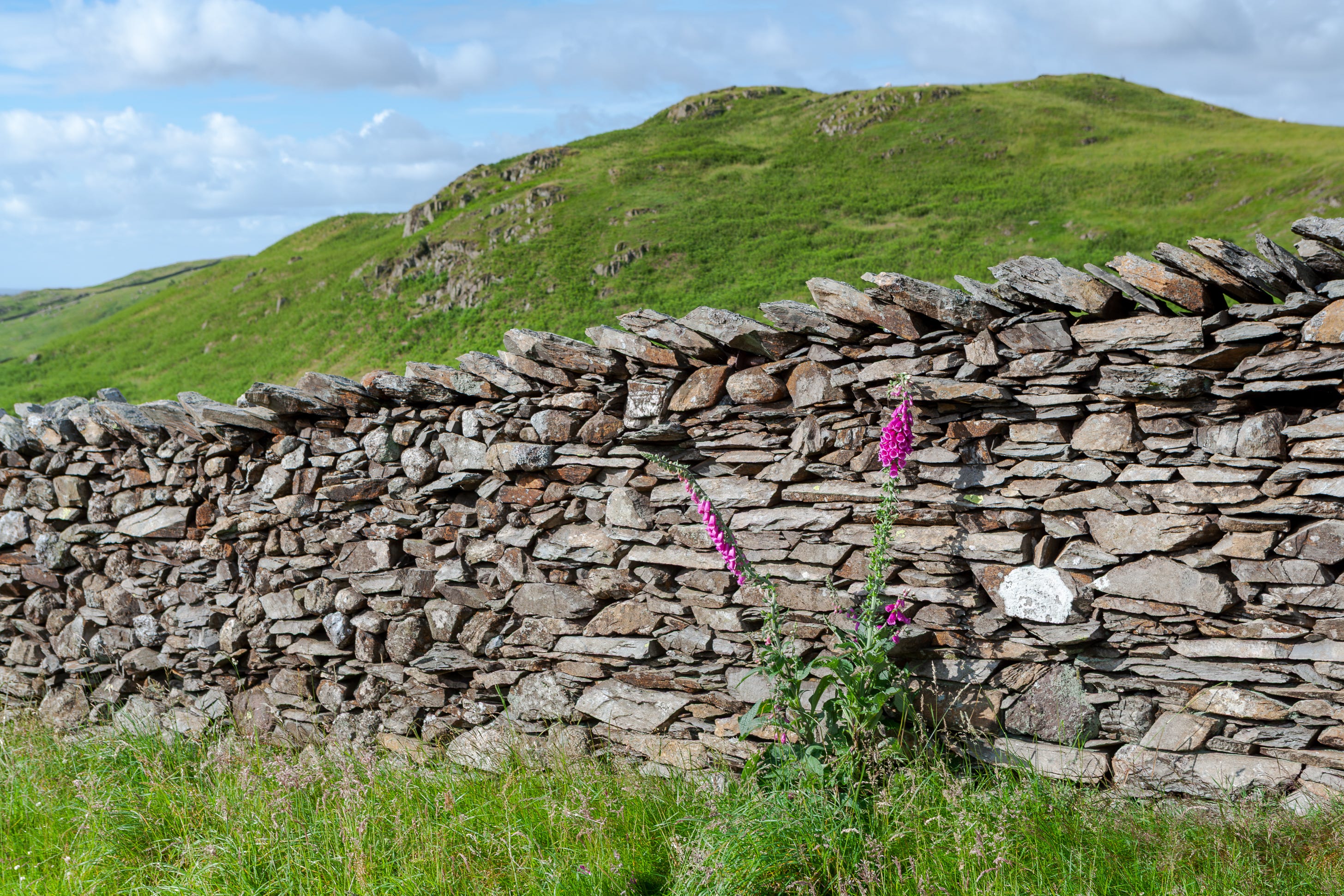
I’ve waited a long time for an excuse to write about dry stone walls.
My justification for introducing dry stone walls into a photography newsletter has been provided by Oscar-winning cinematographer Roger Deakins, who mentioned them at the end of an interview with The Guardian.
“I met a farmer once, and he was doing a stone wall up in Dartmouth. They just lay these stones together without any mortar or anything. It’s just brilliant what they do. And he was just loving the work. Isn’t that just life? You’ve got to love what you do, whatever it is. It doesn’t have to be film-making; it can be anything.”
– Roger Deakins from The Guardian
Dry stone walls are marvellous. In the UK, it’s estimated there are 180,000 miles of dry stone walls. That’s 14 times longer than the Great Wall of China. They mark the boundaries of farmland, separate pastures and edge footpaths. They don’t use cement or mortar, yet many have been standing for centuries.
They’re formed by judicious placement of stones, woven into a three-dimensional jigsaw, each layer bonding with the next. The glossary of dry stone walling terms is as poetic as the landscapes the walls delineate. You might, when wandering through the British countryside, encounter a dry stone waller at work, and they’ll speak affectionately about their heartings, pinnings, squeezes and ha-has.
The formation of a dry stone wall’s layers is dependent upon the natural shape of local stone. In Cumbria, uncompromising slate and blocky greywacke create sturdy, irregular patterns, whilst the consistency of Dorset limestone creates more uniform courses (layers) and allows for artistic, angled arrangements.
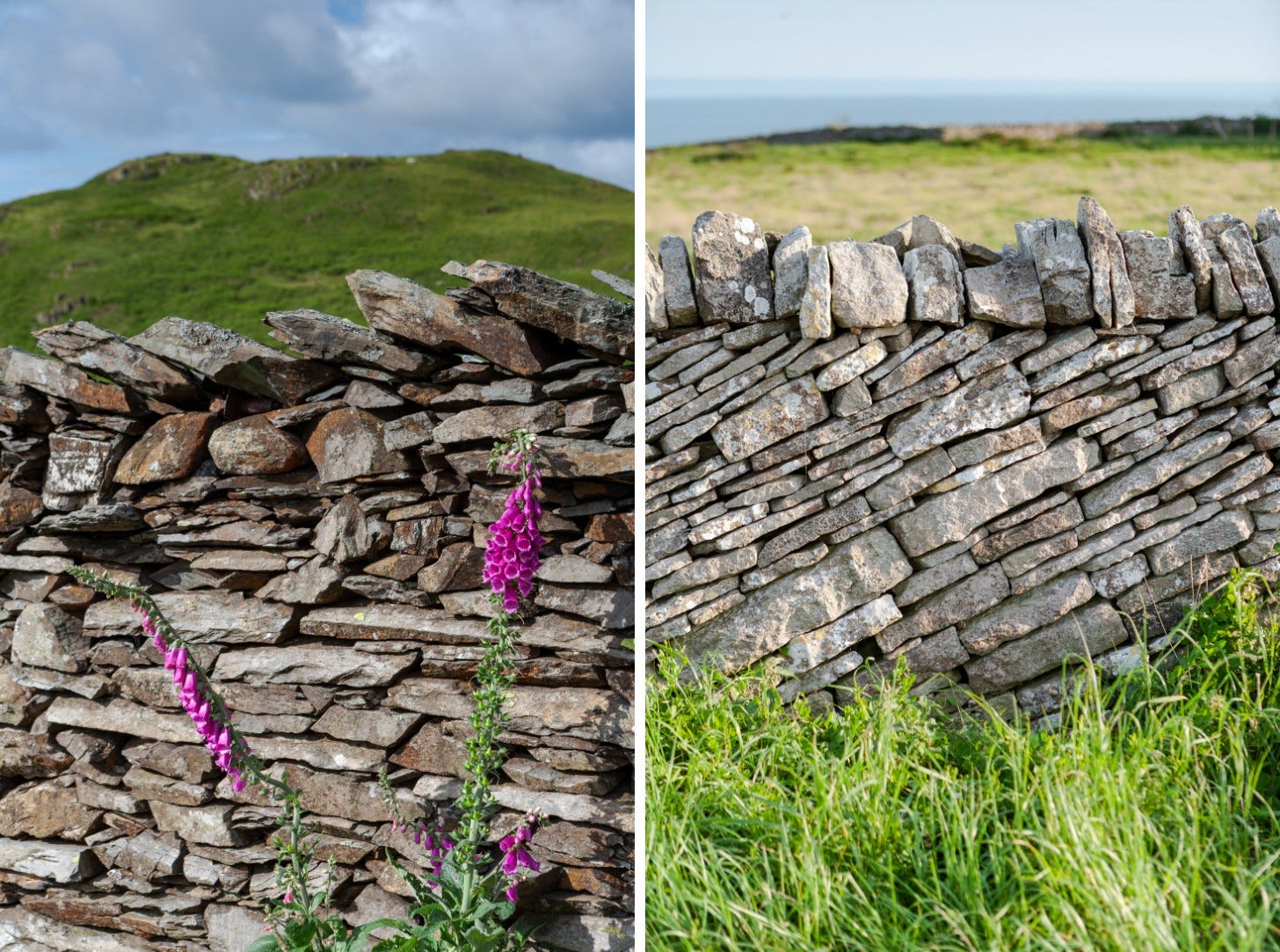
Walls might be single or double-width, the latter bonded with through stones. The tops of walls are crowned with coping stones, which serve as added protection against the elements and as an artistic flourish.
Dry stone walling is an art. It’s not simply a matter of picking the nearest stone to add to a wall. Experienced wallers can recognise which shapes will fit together; they will flip a stone over and turn it around in their hands, instinctively finding the best orientation. A well-built dry stone wall looks as if each stone was intended to rest in one position and one position only. Dry stone wallers have developed the mystical skill of stone divination.
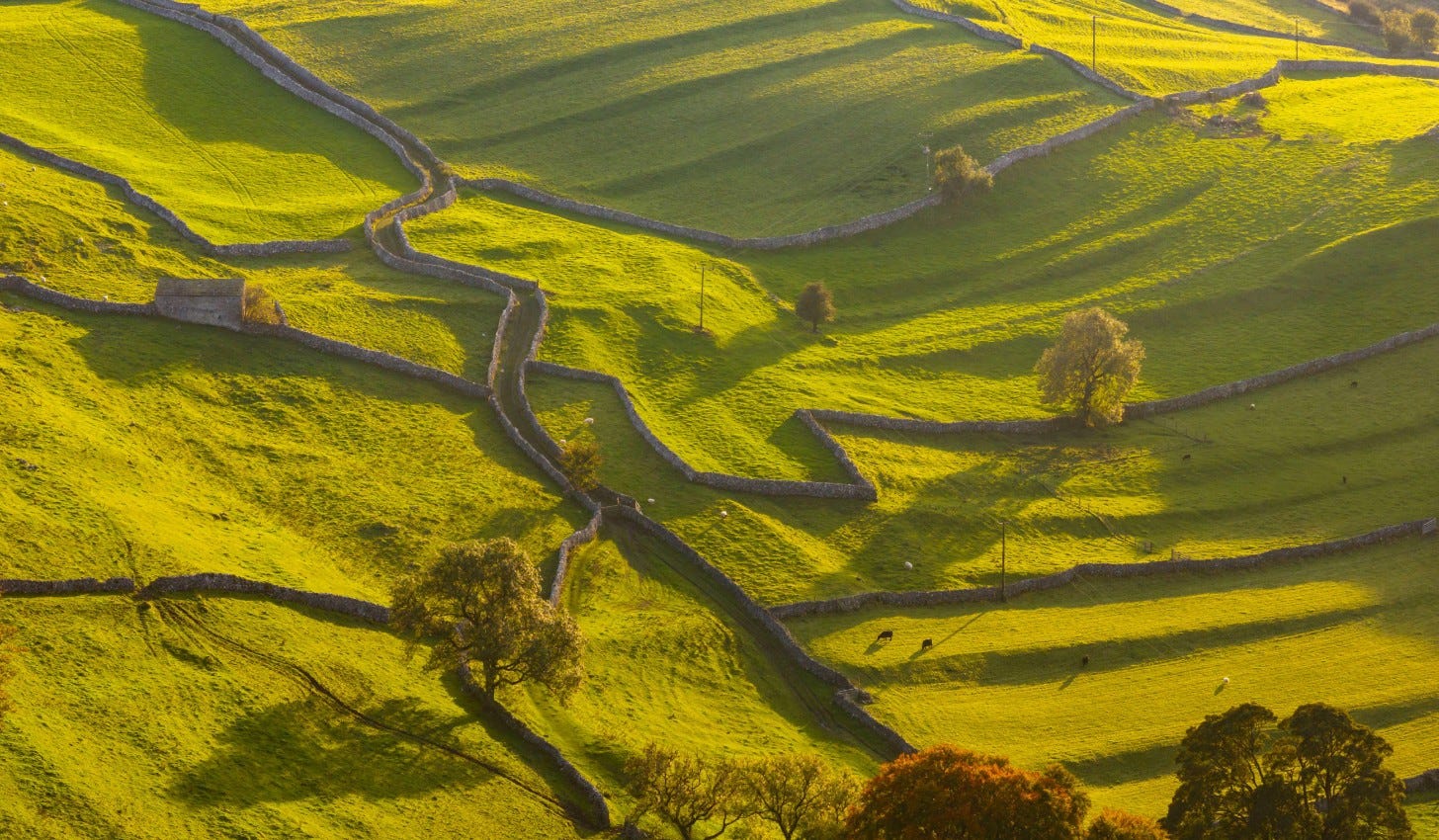
Nowhere is the dry stone wall a more integral part of the landscape than the Yorkshire Dales, where walls describe a mosaic pattern of pastures and cast lengthening shadows at sunset.
In another life, I would have enjoyed learning the art of dry stone walling. It’s an outdoor pursuit, physically demanding but thoughtful and considered too. It requires logic and an appreciation of the gentle undulations in the landscape.
They say it takes one person one year to build one mile of wall. I imagine that a day spent building a stretch of dry stone wall would be a satisfying one – turning the stones and weighing each in your hands, shoulders warmed by the sun, with the sound of skylarks overhead. When I daydream about dry stone walls, it’s always summer and never raining.
If you’d like a more expert introduction to dry stone walls – and I assume that you would – this short video is a good place to start.
And so I’ve managed to introduce dry stone walls into a photography newsletter by way of a short quote from the man they call The Master of Light, Roger Deakins, so it’s only right that I should return the favour.
Sir Roger Deakins
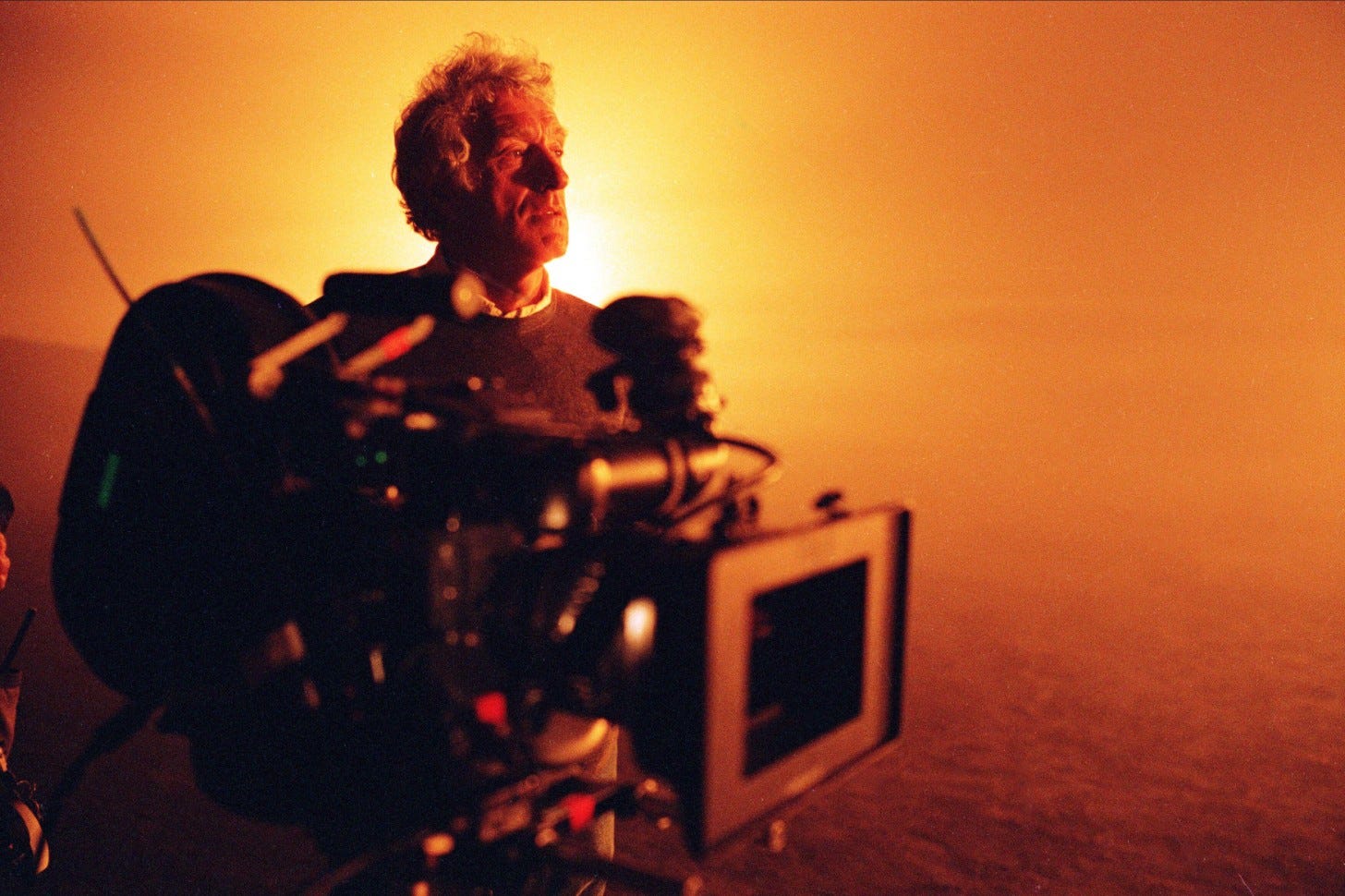
If you were to list your ten favourite films, there’s a high probability that Roger Deakins will be the cinematographer credited on more than one.
The Shawshank Redemption, Nineteen Eighty-Four, Fargo, The Big Lebowski, O Brother, Where Art Thou?, No Country for Old Men, Sicario, Skyfall… Roger Deakins’ credits read like a list of the most memorable films of the last 50 years.
He’s been nominated for an Oscar 16 times and won the Academy Award for best cinematography twice, for Blade Runner 2049 and Sam Mendes’ one-shot masterpiece, 1917. His list of awards and nominations is so extensive it has its own Wikipedia page.
However, Roger Deakins is not very Hollywood. In interviews, he appears diffident. His Oscar acceptance speeches in 2018 and 2020 were modest and grateful, acknowledging the work and support of others. In a recent appearance on BBC’s Desert Island Discs, he spoke about a challenging childhood and rebellious teenage years. He’s travelled far – in every sense – from the sleepy English seaside town of Torquay.
Roger Deakins’ Still Photography
Deakins’ love of the visual arts began with still photography, making black-and-white studies of the towns near his home on the south-west coast of England.
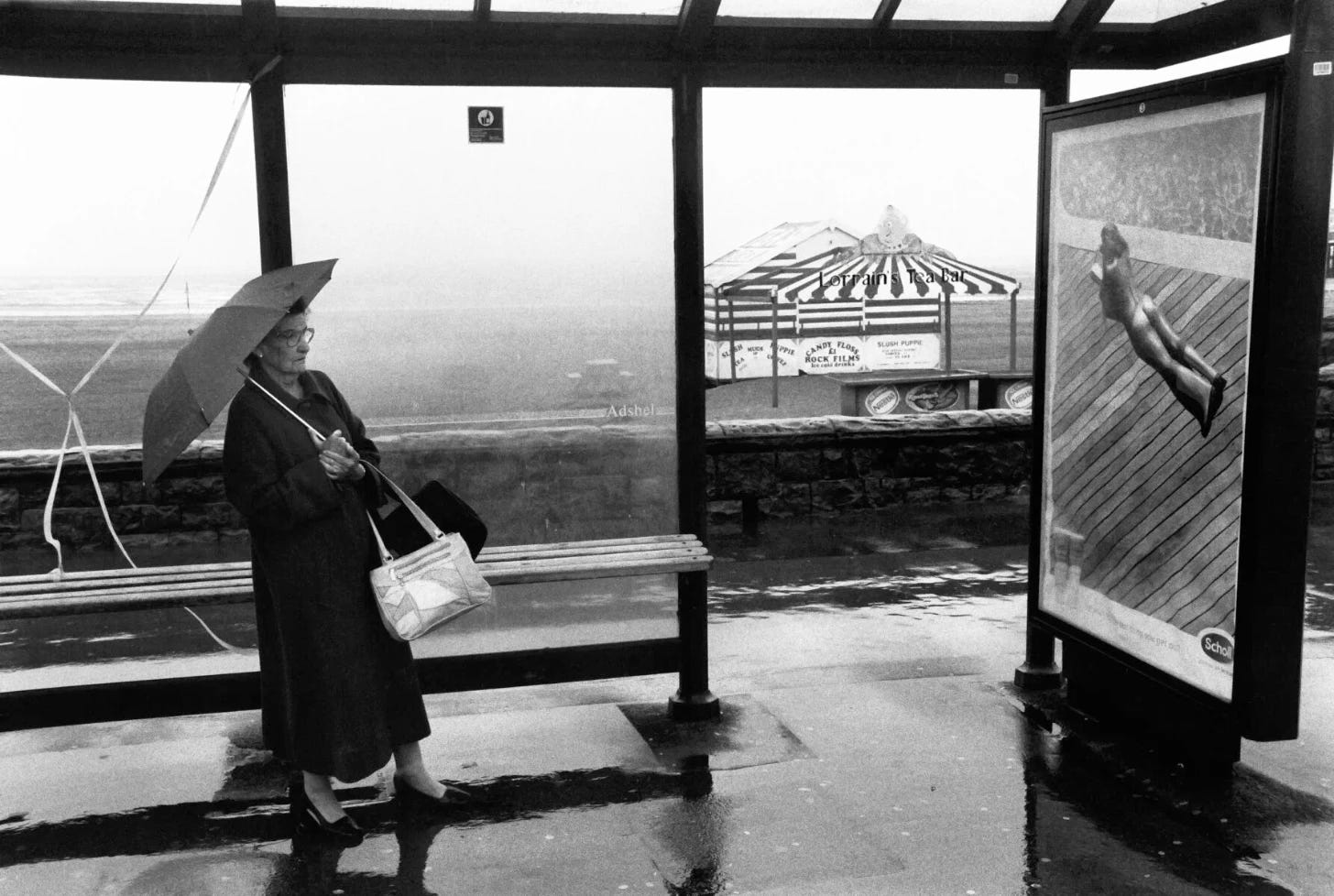
This picture of a rainy bus stop in Weston-super-Mare is typical of the work found in his first photography monograph, Byways. Deakins’ photographs are gentle observations from somebody who’s admittedly most comfortable when framing the world through a lens (he still does all his own camera work). His compositions are, dare I say, cinematic. He’s said that, on occasion, he would sleep on the beach at Weston-super-Mare in order to “catch the early morning light”.
It’s astonishing to think that the same person who made these gentle monochrome pictures is also responsible for the audacious, vibrant camera work in Blade Runner 2049.
A copy of Byways is resting on my desk as I write this.

Only one image in the book hints directly at Deakins’ Hollywood career: Dame Judi Dench’s chair beside James Bond’s iconic Aston Martin DB5, as seen in Skyfall. I love the detail of, presumably, Dame Judi’s shoes.
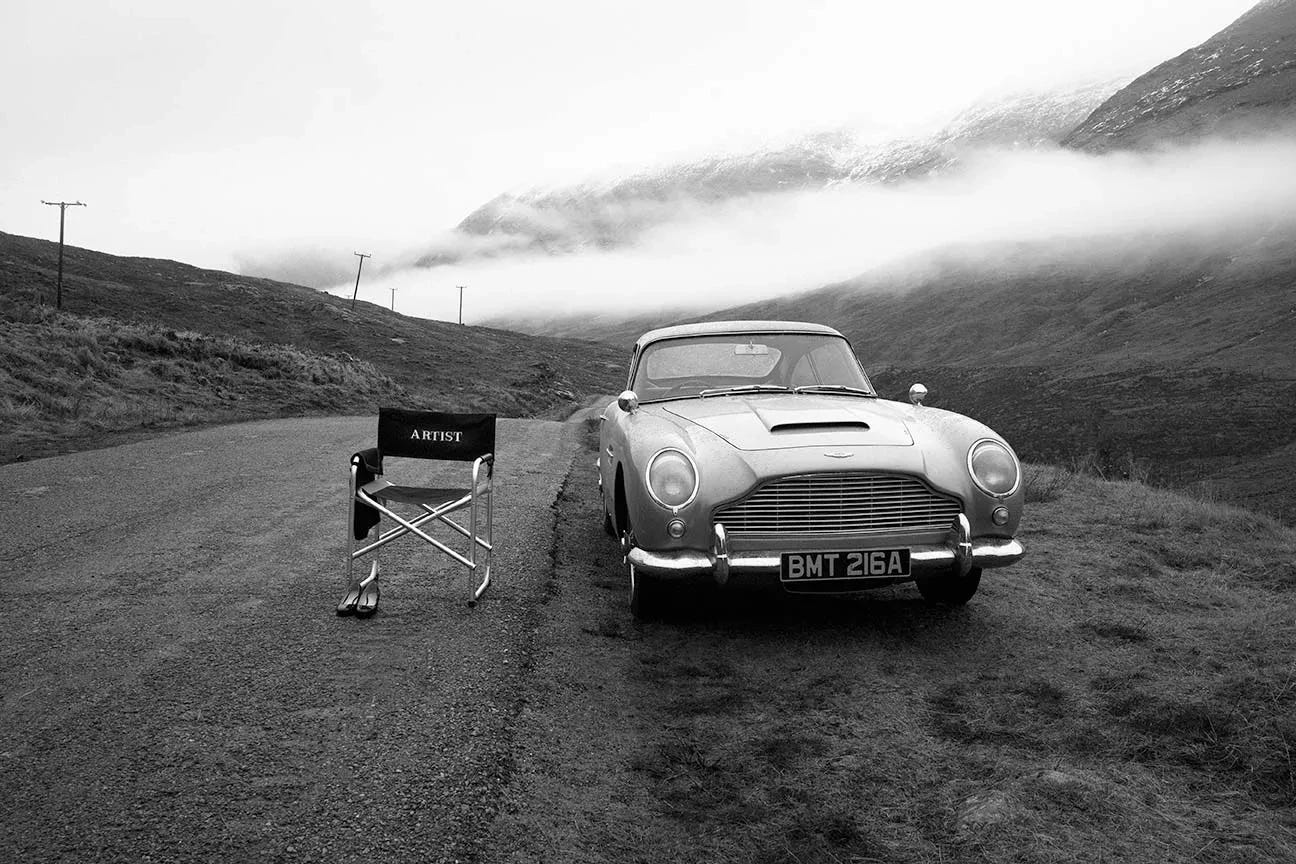
Whilst there are other photos Deakins made when working on films, he has resisted the temptation to photograph the glamorous Hollywood stars, instead focusing on details that might be found beyond the film set.
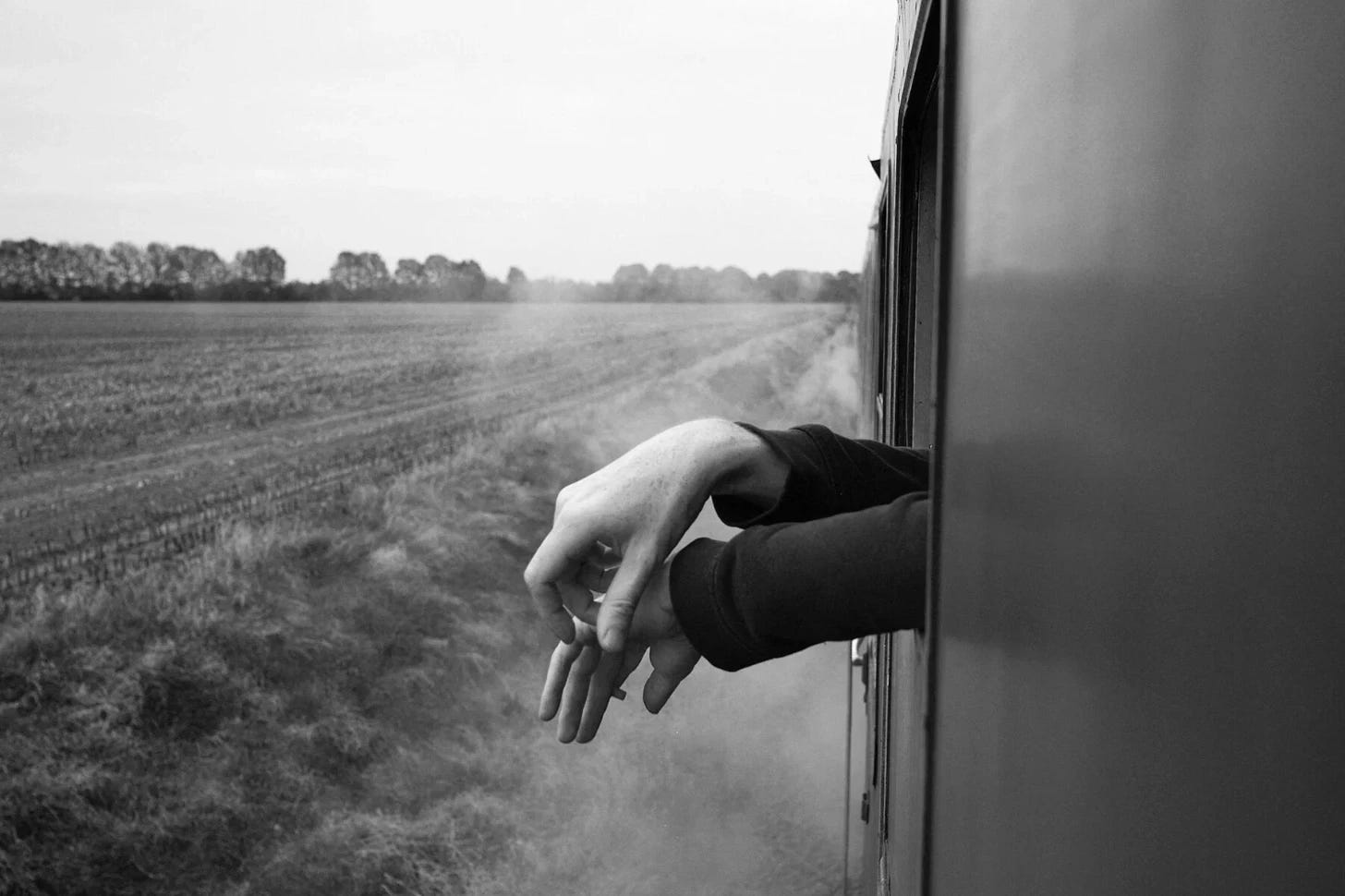
A review of Byways on the Independent Photographer website sums up the Deakins approach: “photography has often been a solitary endeavour, an antidote to the ‘enjoyable’ yet intensely collaborative process of working on films. He is, in his own words, a private person, for whom photography is ‘an excuse to spend many hours just walking’ with ‘no specific purpose but to observe’.”
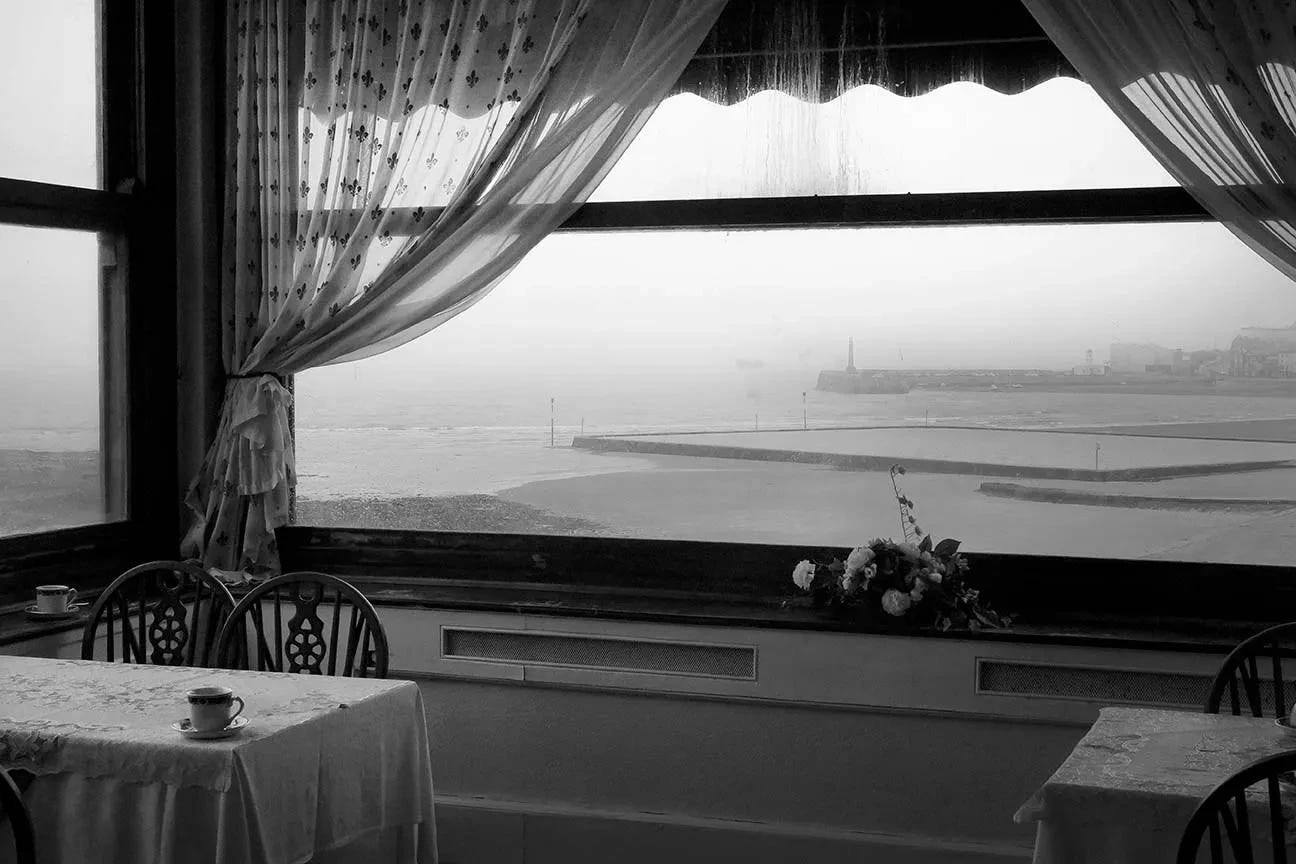
One of my favourite pictures in Byways is a seemingly unremarkable scene: a corner of a tea shop in Margate. The mist-covered beach beyond the condensation-streaked window is as empty as the tables inside. A solitary teacup perches on the very corner of a table. Another cup sits shyly on a window ledge. It’s a scene that captures the melancholy which anybody who’s visited Margate on a drizzly winter’s day will recognise.
Roger Deakins is something of an enigma. Despite an unpromising childhood – he was advised that working in a bank would be the most fulfilling thing life would offer him – his artistic instincts have led to a vaunted career and a place at Hollywood’s top table. Yet he remains reassuringly grounded and now, with his wife and professional collaborator James Ellis Deakins, continues to build a modest but generous programme of home-made podcasts and YouTube videos.
Deakins’ latest book, Reflections, is a visual memoir, telling the stories behind his cinematography work on so many much-loved films.

Readers can learn more about Roger Deakins’ work on his website, where membership registration is free.
“Maybe it sounds a bit pretentious, but I always think life experience is more important than technical knowledge.”
– Sir Roger Deakins
The Wider Angle
Bangkok Fieldnotes Workshop
Magnum photographers Jim Goldberg and Mark Power will be hosting a photography workshop in Bangkok next year.

The Bangkok Fieldnotes workshop promises an insight into two very different approaches to photography and will include opportunities to work alongside the two lead photographers, with sessions on editing and sequencing, plus the creation of a group zine.
6–12 February 2027. £1,650 (workshop only).
Inge Morath Award 2026
Ukrainian photographer Dara Petrova is the recipient of this year’s Inge Morath Award for her ongoing project, Circle.

“Circle captures everyday life in Ukraine from a local perspective, where everything speaks of war. Yet there is no visible combat in the photographs; only the dates and times reveal the context. This is not documentary photography, but the gaze of a Ukrainian woman who, like many others, ‘feels guilt for surviving, for doing too little, for not winning – and for being a woman and escaping conscription so easily’.”
– From the World Photography Organisation
It might not be immediately obvious that Dara’s images are from a war-torn country, but, as in all things, context is everything: there is no military action in the pictures, yet they are photographs of war.
Perfect Days
A recent article in The London Economic magazine reminded me of the 2024 Oscar-nominated film Perfect Days.
It’s described as “one of the most life-affirming films you’ve never seen”. In fact, I have seen it – more than once – and agree that it’s a welcome antidote to recent news cycles. It’s also achieved the unlikely result of prompting me to add “Tokyo Public Toilets” to my bucket list.
Perfect Days is directed by Wim Wenders and features Kōji Yakusho in a memorable leading role as Hirayama, a man who lives in a modest Tokyo apartment, owns few possessions, and listens to Lou Reed and Van Morrison on cassette tapes whilst driving between Tokyo’s public toilets (the soundtrack is full of classics).
During his breaks, Hirayama takes photographs of trees and keeps prints in carefully labelled tin boxes stacked in his wardrobe.
Perfect Days is a film that celebrates the beauty to be found in the quotidian and the delight that can be discovered in the everyday. If the story were set in Yorkshire, I suspect Hirayama would be building dry stone walls.
Perfect Days, which – in case I haven’t sold it to you yet – includes a Japanese version of ‘The House of the Rising Sun’, can be found on Apple TV.
And finally…
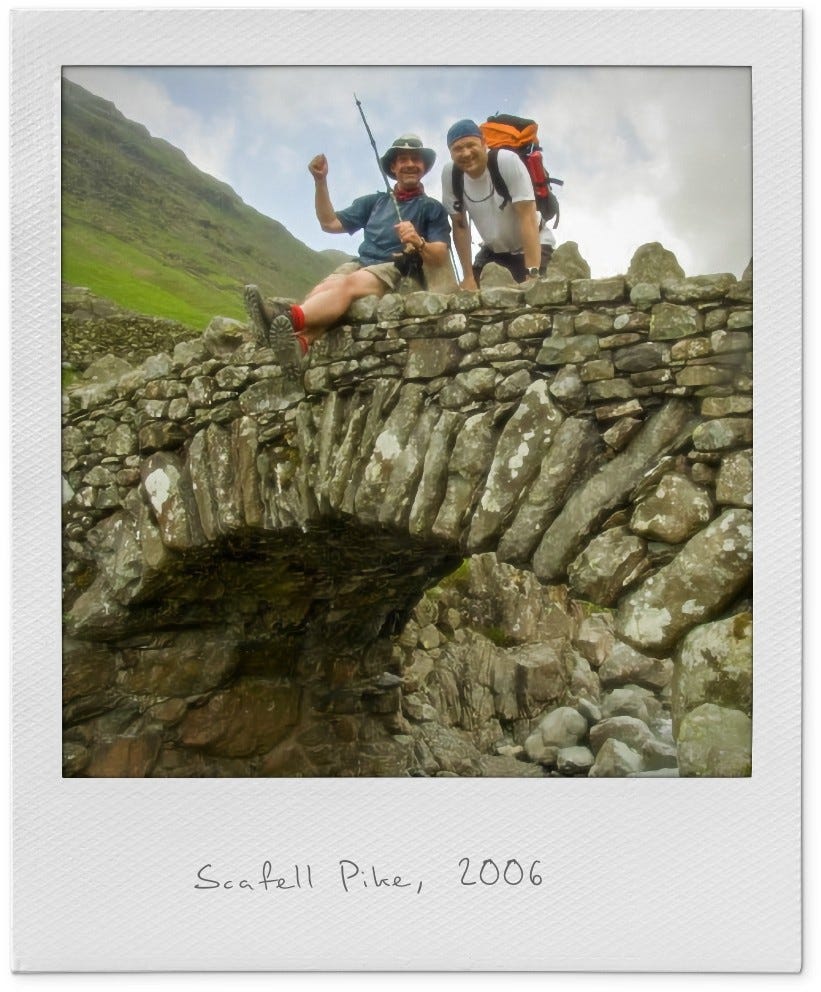
Searching my archive for photos of dry stone walls, I was reminded that it’s been 20 years since my uncle and I spent a long weekend climbing the highest peaks in Scotland, England and Wales (Ben Nevis, Scafell Pike and Snowdon – now officially Yr Wyddfa).
The Three Peaks Challenge can be completed in 24 hours by fundraisers, princesses, or anyone in a hurry. We took a little longer, not least because there were many dry stone walls and the occasional dry stone bridge to be photographed along the way.
Thanks for stopping by. I’m going to spend the rest of the day watching Roger Deakins’ films, photographing trees, and listening to the Velvet Underground, which is a good way to spend a Sunday.
Go well.

✤ Creative Inspiration
Lateral-thinking prompts, inspired by Brian Eno’s Oblique Strategies, designed with photographers in mind.

Read more and learn how to use my Creative Strategies for Photographers.

Indeed Perfect Days is a lovely film and definitely worth watching more than once. I’ll be off to do that now. The other topics also very interesting. I’d forgotten about Desert Island discs. I’ve got a busy day ahead of me. :-)